Joyreal Magnetic Tiles: Screen-Free STEM Learning
Discover why Joyreal magnetic building tiles are the go-to STEM toy for parents. Learn about features, developmental benefits, and how to maximize creative play for toddlers and preschoolers.
Over 85% of parents struggle to find toys that genuinely hold their child's attention while building real skills—and magnetic tiles are quietly revolutionizing how we think about screen-free play. The search for toys that balance entertainment with genuine learning often feels frustrating, with many options overpromising and underdelivering on both fronts.
Joyreal's magnetic building tiles have become a staple in homes and classrooms because they hit a sweet spot: affordable pricing ($20-$60 depending on set size), durability that survives rough toddler hands, and genuine educational value that supports spatial reasoning and fine motor development. Parents consistently report that these tiles capture their children's attention for extended periods while naturally building foundational math and engineering concepts.
Why Magnetic Tiles Work for Preschool-Aged Learners (Ages 3-5)
Developmental readiness: How preschoolers' fine motor skills align with tile manipulation
Three-year-olds are at a critical stage for developing hand strength and coordination. Magnetic tiles require enough grip strength to manipulate without being frustratingly difficult, making them perfectly calibrated for this developmental window. The act of picking up a tile, positioning it against another, and feeling the magnetic connection snap into place engages multiple sensory systems simultaneously.
Cognitive benefits of open-ended construction play without prescribed instructions
Unlike puzzles with one correct solution, magnetic tiles offer infinite possibilities. A child can build whatever emerges from their imagination—a tower, a flat pattern, a robot, an abstract creation. This open-endedness is precisely what develops creative thinking and problem-solving skills. Without step-by-step instructions dictating the outcome, children learn to make decisions, experiment with arrangements, and trust their instincts.
How color recognition and shape sorting naturally occur during building sessions
Preschoolers naturally gravitate toward organizing tiles by color or shape during play. A child might decide to build with only blue tiles, or separate all the triangles from the squares. These categorization exercises strengthen cognitive organization skills without feeling like formal instruction. The act of noticing patterns and grouping similar items builds foundational math concepts organically.
The role of magnetic feedback in teaching cause-and-effect relationships
The satisfying click when two tiles connect teaches cause and effect in real time. Push the tile toward another, and the magnet pulls it into place. Remove a tile from the bottom of a tower, and the structure potentially collapses. These immediate, tangible consequences help young minds understand how actions produce results—a core concept underlying all learning.
Why this age group shows immediate engagement compared to other STEM toys
Magnetic tiles deliver instant gratification. A toddler can create something recognizable within seconds, earning immediate success and motivation to continue building. Many other STEM toys require more setup, instruction, or patience before results appear. The magnetic tiles' low barrier to entry combined with high reward keeps preschoolers engaged far longer than toys requiring adult facilitation.
Supporting independence and confidence through successful, quick-win creations
Every tower a child builds is a victory. Every structure they create is an accomplishment they can see and touch. This consistent pattern of small successes builds genuine confidence and independence. Children learn that they can figure things out without adult help, fostering a sense of agency that extends beyond playtime.
Sensory appeal: Tactile feedback, visual stimulation, and satisfying magnetic clicks
The translucent tiles offer visual interest as light passes through them. The tactile sensation of holding smooth plastic and feeling magnetic resistance provides rich sensory input. The auditory feedback—that satisfying click when tiles connect—creates a multisensory experience that keeps children engaged. This sensory richness is why children often build for longer periods with magnetic tiles compared to other construction toys.
Building Spatial Reasoning Through 3D Construction
How 2D tile arrangements introduce foundational geometry concepts
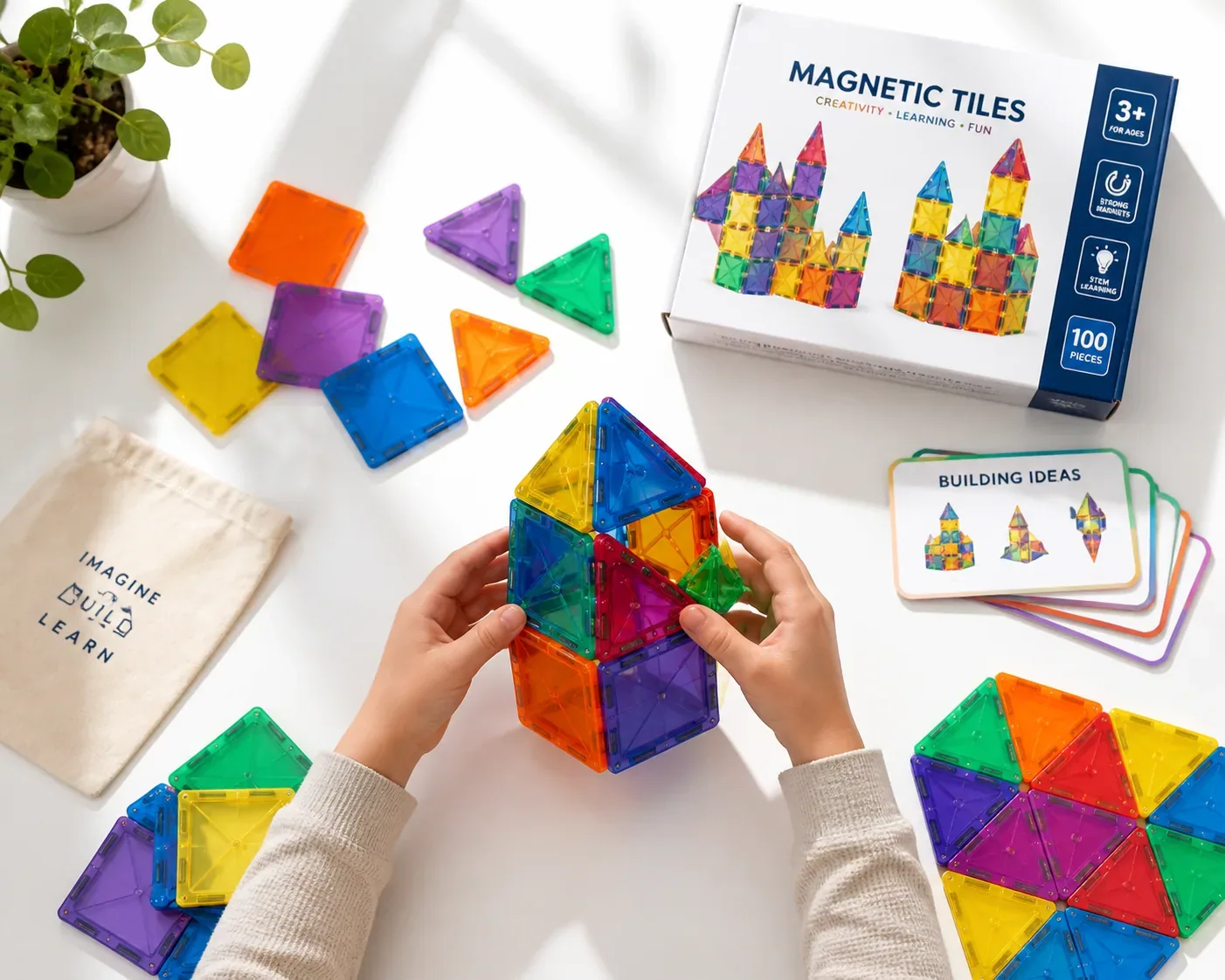
Starting with flat designs on a table, children encounter geometric shapes directly. Arranging squares and triangles on a surface naturally introduces concepts like symmetry, patterns, and tessellation. These visual geometry lessons become embedded in their spatial understanding without formal instruction or worksheets.
Progression from flat designs to multi-level 3D structures and what it teaches
As children gain confidence, they naturally progress from 2D layouts to building upward. This transition introduces structural thinking—understanding how to stack tiles so they remain stable, how to create balance, and how different arrangements affect overall stability. The progression from flat to three-dimensional thinking mirrors the mathematical concepts children will encounter in later education.
Problem-solving moments: Balancing, stability, and structural integrity challenges
When a tower wobbles, a child must experiment with solutions. Should they make the base wider? Use heavier tiles? Add more support structures? These hands-on problem-solving sessions develop engineering intuition. Children learn through trial and error which configurations work and which fail, building resilience and experimental thinking naturally.
Connection between magnetic tile play and later math and engineering understanding
Research consistently shows that hands-on construction play in early childhood correlates with stronger math and spatial reasoning abilities later. The intuitive understanding of balance, proportion, and structure that children develop with magnetic tiles becomes the foundation for geometry, algebra, and eventually engineering concepts.
Real-world examples of structures kids naturally build (towers, houses, vehicles)
Watch children play with magnetic tiles and you'll see the same structures emerge repeatedly: tall towers testing height possibilities, rectangular structures becoming houses, and creative interpretations of vehicles. These naturally occurring builds demonstrate how children translate real-world objects into magnetic tile constructions, strengthening their ability to visualize and represent three-dimensional objects.
How trial-and-error with tiles builds resilience and experimental thinking
When a tower falls, there's no penalty—just an opportunity to rebuild differently. This low-stakes environment encourages experimentation. Children learn that failure is information, not judgment. They develop the resilience to try again, adjust their approach, and persist through challenges. This experimental mindset becomes invaluable across all learning domains.
Translucent tiles' unique advantage: Seeing internal magnetic connections and structure
Unlike solid construction materials, Joyreal's translucent tiles allow children to see the magnets inside. This transparency deepens their understanding of how the system works. Children can observe the magnetic field interaction and develop intuitive knowledge of how magnetic attraction functions, adding a physics education component to regular play.
Durability and Longevity: What Parents Should Expect
ABS plastic construction: Why it resists cracks better than cheaper alternatives
Joyreal uses ABS plastic, the same material used in LEGO bricks and other durable toys. This material resists cracking better than lower-quality plastics when dropped or squeezed. The choice of material directly impacts whether tiles survive years of rough toddler handling or require replacement after months.
Magnet strength variations: Understanding why smaller pieces may have weaker magnets
Smaller tiles contain smaller magnets, which naturally produce weaker magnetic fields than larger tiles. This is a physics limitation, not a manufacturing flaw. Understanding this helps parents set realistic expectations—smaller specialty pieces may not hold weight as effectively as larger squares or triangles. Joyreal addresses this constraint with thoughtful magnet placement.
Common wear patterns and when tiles typically need replacement
With regular use, tiles typically remain fully functional for 3-5 years. The most common wear issues include small cracks at corners (from drops), fading colors (from sunlight exposure), and occasionally decreased magnet strength in heavily used pieces. These aren't sudden failures but gradual wear patterns. Individual tiles can be replaced without replacing the entire set.
Proper storage methods to extend tile lifespan and maintain magnet strength
Store tiles in a cool, dry location away from direct sunlight, which can fade colors over time. Avoid storing near other strong magnets that might gradually weaken the tile magnets through opposing magnetic fields. A dedicated storage box or container keeps tiles organized and protected. Many parents use clear plastic bins with dividers to sort by color and shape, which also simplifies cleanup and extends lifespan by preventing damage during storage.
Compatibility with other major magnetic tile brands for expanding play possibilities
Joyreal tiles are compatible with other major brands including Magna-Tiles and Picasso Tiles. This compatibility matters because parents often expand collections gradually. You can start with an entry-level Joyreal set and later add specialty pieces from other brands without limitations. This flexibility is a significant advantage over toys with proprietary systems.
Cleaning and maintenance tips for keeping tiles hygienic and functioning
Tiles can be wiped clean with a damp cloth and mild soap. This matters in shared environments like preschools where hygiene is essential. Regular cleaning prevents dirt buildup in seams and around magnets. Allow tiles to dry completely before storage to prevent mold or mildew. Simple maintenance routines keep tiles hygienic and functioning optimally for years.
Warranty considerations and manufacturer support for defective pieces
Joyreal typically offers warranties covering manufacturing defects. If a tile has weak magnets or cracks immediately after opening, manufacturer support is usually available. Understanding warranty terms before purchase provides peace of mind and helps justify the investment. Quality manufacturers stand behind their products, which signals confidence in durability.
Creating Intentional Play Spaces for Maximum Engagement
Setting up a dedicated magnetic tile station versus portable play options
A dedicated station with a low table and organized tile storage encourages frequent use. Alternatively, magnetic tiles work well in portable containers for on-the-go play at grandma's house or during travel. The choice depends on your family's lifestyle. A permanent station signals to children that tiles are important and available, increasing engagement. Portable options offer flexibility but require more setup and cleanup.
Surface recommendations: Best tables, mats, and play areas for stability
Flat surfaces with minimal vibration provide the best building foundation. A dedicated play table works best, though any stable, level surface suffices. Magnetic tiles stick to metal surfaces, which can be problematic if your table has a metal frame. Some parents use a magnetic board as their building surface, which contains tiles naturally without requiring a surrounding floor space. Avoid soft surfaces like couches, which provide unstable building foundations.
Organizing tiles by color or shape to encourage different building approaches
Clear storage containers with dividers organized by color encourage different building choices. Some days a child might grab the red tiles only, creating a monochromatic structure. Other days they might select triangles exclusively. This organizational approach naturally encourages varied creative approaches. When all tiles are mixed together, children often grab randomly, missing opportunities to explore color or shape-based building themes.
Rotation strategies: Storing some tiles away to refresh novelty and engagement
Children's interest naturally fluctuates with familiarity. Rotating which tiles are available—storing some away periodically and bringing them back later—refreshes engagement. Tiles children haven't seen in a month suddenly feel new and exciting. This simple strategy extends the lifespan of engagement without purchasing additional sets.
Combining Joyreal tiles with complementary toys (cars, figurines, blocks)
Magnetic tiles work beautifully in combination with other toys. Small cars can race through tile-built tracks. Figurines can inhabit tile houses. Traditional blocks can complement tile structures. This combination play deepens imaginative scenarios and extends engagement. Children create narratives where their tile buildings become settings for character-driven stories.
Screen-free play scheduling: How to integrate tiles into daily routines
Designate specific times when tiles are the primary entertainment option. This might mean after school before homework, or during a rainy afternoon. Treating tiles as a scheduled activity increases engagement and reduces screen time during those specific windows. Some families find that having tiles immediately visible makes children choose them naturally over screens.
Group play dynamics: Solo building versus collaborative construction projects
Magnetic tiles work equally well for solo play and group activities. Solo play develops independent creativity. Group play introduces collaboration, negotiation, and shared decision-making. A parent and child building together creates bonding opportunities and allows adults to gently guide thinking without directing outcomes. Multiple children building simultaneously introduces social dynamics and sometimes friendly competition.
Developmental Milestones and Learning Outcomes
Fine motor skill progression: Grip development and hand-eye coordination gains
Early in play, children use full-hand grips to manipulate tiles. Over weeks and months, grip becomes more refined and precise. Hand-eye coordination improves as children accurately position tiles against each other. These fine motor improvements transfer to handwriting readiness, utensil use, and other activities requiring precise hand control.
Color recognition and sorting skills naturally embedded in play
Children constantly recognize colors as they build, naming tiles and organizing by hue. This repeated color identification strengthens recognition without flashcards or formal instruction. Sorting games—building with only one color or separating colors—formalize this learning while maintaining playful engagement.
Spatial awareness and mental rotation abilities that emerge over time
As children build more complex structures, they develop the ability to visualize three-dimensional objects mentally. They understand how a tile placed one way looks different from the same tile rotated. This mental rotation ability is strongly correlated with math achievement and spatial reasoning in later education.
Problem-solving and critical thinking through structural challenges
Each time a structure fails to stand, a problem emerges that requires thinking. This consistent pattern of identifying problems and experimenting with solutions develops critical thinking naturally. Children learn to ask themselves "Why did that happen?" and "What could I try differently?"
Creativity and imaginative play without rigid rules or end goals
Unlike games with specific winning conditions, magnetic tiles celebrate open-ended creativity. Any structure a child builds is valid and valuable. This freedom from rules encourages creative expression and imaginative play. Children invent narratives about their structures and explore possibilities without concern about "correct" outcomes.
Social skills development when multiple children build together
Group tile play involves sharing materials, discussing building ideas, and sometimes compromising on design choices. Children learn to listen to peers, accept suggestions, and collaborate toward shared goals. These social skills develop naturally through shared play without formal instruction.
Long-term cognitive benefits: Research-backed STEM learning outcomes
Research consistently demonstrates that hands-on construction play improves spatial reasoning, math performance, and problem-solving abilities. Children who engage regularly with construction toys show measurable advantages in geometry understanding and engineering thinking. The benefits extend years beyond the period of active play.
Budget-Friendly Expansion and Set Selection
Entry-level sets ($20-$35): What's included and best for beginners
Entry-level Joyreal sets typically include 30-50 pieces with basic shapes: squares, triangles, and perhaps a few specialty pieces. These sets are ideal for testing whether your child engages with tiles or determining if the learning style matches your goals. Entry-level pricing makes the investment low-risk while providing genuine play value.
Mid-range options ($35-$50): Expanded shape variety and piece count
Mid-range sets include 60-100+ pieces with greater shape variety. Additional shapes like diamonds, pentagons, or specialty pieces like windows expand building possibilities. These sets offer better value per piece and support more complex construction projects without the premium pricing of larger sets.
Premium sets ($50+): Specialty pieces, larger quantities, and advanced building
Premium sets include 100+ pieces, comprehensive shape variety, and specialty components. These sets support ambitious building projects and allow multiple children to build simultaneously without running out of pieces. Premium pricing is justified by expanded possibilities and quantity.
Cost-per-piece analysis to identify the best value options
Calculate the cost per piece by dividing total price by piece count. Mid-range and larger sets typically offer better cost-per-piece value than entry-level sets. However, entry-level sets provide better overall value if your child may not engage deeply with tiles. Analyzing cost-per-piece helps identify the most efficient investment for your family's situation.
When to buy larger sets versus gradually expanding a collection
Starting with entry-level sets and expanding gradually allows you to match investment to actual engagement. If your child plays daily, expansion is justified. If tiles sit unused, spending more money isn't wise. Gradual expansion also allows you to replace worn pieces and add variety over time without large upfront costs.
Seasonal sales and bundle opportunities for maximizing budget
Major retailers often discount magnetic tile sets during holiday seasons, back-to-school periods, and end-of-season clearance events. Bundled sets combining different piece types often offer better value than individual purchases. Monitoring sales and purchasing strategically extends your budget further.
Resale value: Why quality magnetic tiles hold their worth
Quality magnetic tiles retain significant resale value because they're durable and always in demand. When children outgrow tiles, you can recoup 40-60% of the purchase price through resale, reducing your net investment. This strong resale value is another advantage over cheaper toys that hold little secondary market value.
Safety Considerations and Age-Appropriate Play
Smooth rounded edges and why they matter for toddler safety
Joyreal tiles feature smooth, rounded edges rather than sharp corners. This design choice matters significantly for toddlers who might fall on or bump into tiles during play. Rounded edges reduce injury risk without compromising durability or functionality.
Magnet strength: Ensuring pieces aren't small enough to be choking hazards
Tiles are constructed so magnets are securely embedded and not small enough to be choking hazards independently. The tiles themselves are large enough that they don't meet choking hazard size criteria for children over three years old. However, supervision remains important for younger toddlers who still mouth objects.
Supervision guidelines for different age ranges (3+, 5+, older siblings)
Three-year-olds benefit from nearby adult supervision, especially early in play while they're establishing boundaries. Five-year-olds can often play independently with periodic check-ins. Older siblings can play unsupervised and often become mentors to younger children, introducing them to building techniques.
Handling rough play: What happens when tiles are dropped or thrown
Tiles can withstand drops and minor throws that might damage other toys. The ABS plastic resists cracking and impacts that would shatter cheaper materials. However, extremely forceful throwing or deliberately slamming tiles on hard surfaces can cause damage over time. Setting expectations around play intensity helps preserve tiles longer.
Hygiene practices for shared play environments (daycare, preschool)
In shared settings, periodic cleaning with disinfectant wipes maintains hygiene. Washing hands before and after play prevents cross-contamination. These simple practices keep shared sets sanitary across multiple children while maintaining tile integrity.
Checking for cracks or damage that could compromise safety
Regular inspection of tiles identifies cracks or damage that might create sharp edges or compromise structural integrity. Small cracks don't require immediate replacement, but visible damage that creates sharp edges should be addressed. This simple maintenance routine keeps play safe.
Storage safety: Keeping tiles away from younger siblings or pets
Store tiles in secured containers inaccessible to younger siblings who might mouth small pieces or pets who might accidentally ingest magnet pieces. Proper storage protects both the tiles and household members who shouldn't access them.
Comparing Joyreal to Other Magnetic Tile Brands
Price positioning: How Joyreal compares to premium and budget competitors
Joyreal positions itself in the middle market—significantly less expensive than premium brands like Magna-Tiles but typically more expensive than budget competitors. This mid-range pricing with solid quality represents strong value for most families. You're paying for quality without premium brand markup.
Magnet strength and durability differences across brands
Premium brands often tout stronger magnets, though the difference may not be noticeable in casual play. Joyreal magnets are adequate for normal building activities. Budget brands sometimes feature noticeably weaker magnets, making structures feel less satisfying and reliable. Joyreal's magnet strength represents a good balance of cost and performance.
Color variety and translucency: What makes Joyreal tiles distinctive
Joyreal's translucent tiles allow light to pass through, creating visual appeal that solid-colored tiles don't offer. The translucency also allows children to see the magnets inside, adding educational interest. Color variety across sets supports themed building and organizational play.
Piece compatibility: Mixing Joyreal with Magna-Tiles, Picasso Tiles, and others
Joyreal tiles are fully compatible with Picasso Tiles and largely compatible with Magna-Tiles, though some size variations exist. This compatibility means you can expand collections by mixing brands without limitations. This flexibility is advantageous for families who want to expand gradually using different brands.
Customer satisfaction and longevity reports from parent communities
Parent communities consistently report positive experiences with Joyreal tiles, noting durability and value for money. Longevity reports suggest most sets remain fully functional for 3-5 years with normal use. This real-world feedback aligns with the product's mid-range positioning and ABS plastic construction.
Unique features: Specialty pieces, carrying cases, or educational guides
Different sets include varying specialty pieces like windows, car bases, or door frames. Carrying cases are sometimes included in premium sets, offering convenient transportation. Educational guides occasionally accompany sets, suggesting building projects. These features vary by set but generally focus on practical functionality rather than premium add-ons.
Value proposition: Why parents choose Joyreal for their first magnetic tile purchase
Parents choosing Joyreal typically prioritize value and quality balance. The brand offers durability better than budget alternatives without premium pricing. For first-time magnetic tile buyers testing engagement and value, Joyreal represents a smart entry point with excellent cost-benefit ratio.
Real-World Play Scenarios and Building Ideas
Simple starter projects: Towers, walls, and basic geometric shapes
When children first encounter magnetic tiles, simple projects build confidence. A child can stack tiles into a tower within seconds and experience immediate success. Walls—flat structures against a surface—introduce planning for horizontal building. Simple geometric shapes like squares or triangles teach shape recognition while creating recognizable forms.
Intermediate challenges: Houses, vehicles, and recognizable structures
As confidence builds, children naturally progress to recognizable structures. A rectangular base becomes a house. Triangular pieces create a roof. Wheels from tile vehicles emerge from creative arrangement. These intermediate projects maintain engagement as skills develop.
Advanced builds: Multi-story buildings, bridges, and complex designs
Experienced builders tackle complex structures requiring planning and problem-solving. A bridge spanning a distance tests structural engineering. Multi-story buildings explore vertical complexity. These advanced projects challenge developing minds and maintain engagement as skills grow.
Themed play: Combining tiles with storytelling and imaginative scenarios
Structures aren't just physical creations but settings for narratives. A tile house becomes a character's home. A tile castle hosts imaginary adventures. Figures or toys interact within tile structures, creating dramatic play that enriches both construction and storytelling skills.
Seasonal building projects: Holiday decorations, seasonal structures
Seasonal themes refresh engagement. Building holiday decorations or seasonal structures ties tiles to calendar events. Winter-themed structures or summer-themed designs create natural connections between play and seasons.
Parent involvement: How to guide without directing the creative process
Rather than instructing what to build, parents guide through questions. "What are you building?" "How could you make it taller?" "What would happen if you moved that piece?" These questions prompt thinking without prescribing solutions. Parental involvement becomes a scaffold for thinking rather than direction-giving.
Photography and documentation: Capturing building progress and celebrating creations
Taking photos of completed structures celebrates accomplishment and documents progress. Children see their work valued, motivating future building. A growing photo collection becomes a visual record of developing skills and ideas. Some families create photo books or share images with extended family.
Making Magnetic Tiles a Long-Term Investment
Longevity: How many years tiles typically remain functional with proper care
With proper storage and normal use, quality magnetic tiles like Joyreal's typically function fully for 3-5 years. Some tiles remain functional longer, though wear becomes more visible. This lifespan makes the investment economically sound when divided by years of use and children who might play with them.
Growing with your child: Advanced building possibilities as skills develop
A three-year-old's simple towers become a five-year-old's structured houses, which later become a seven-year-old's complex buildings. The same tiles support increasingly sophisticated building as developing minds grasp more advanced concepts. Tiles grow with children rather than being outgrown.
Passing down to younger siblings: Durability across multiple children
Quality tiles survive the play of multiple children. Younger siblings inherit sets that older siblings have finished with, extending value across years and children. A set that costs $40 and lasts through three children represents an extremely economical investment.
Resale and donation options when outgrowing the toy
When children genuinely outgrow magnetic tiles, resale recovers significant investment. Online marketplaces, consignment shops, and local parents seeking used sets readily purchase quality tiles. Alternatively, donation to schools, libraries, or childcare facilities gives tiles new life while supporting younger children's learning.
Combining with other learning tools: Integrating tiles into broader STEM education
Magnetic tiles complement other STEM toys and educational tools. Combined with blocks, they offer varied construction experiences. Paired with coding toys, they create structures that robots navigate. Integrated into science projects, they support physics exploration. Tiles become part of a broader educational ecosystem.
Building a collection over time versus buying all at once
Some families prefer purchasing complete collections immediately. Others gradually expand over years, adding specialty pieces and shape variety. Gradual expansion allows learning about which pieces get most use and tailoring purchases to actual play patterns. This approach is more economical for families uncertain about engagement levels.
Community play: Sharing sets with friends, preschools, or toy libraries
Shared tile sets among friends reduce individual costs while maintaining access. Preschools incorporating tiles into regular activities leverage shared investment across multiple families. Toy libraries offering magnetic tiles for checkout let families try before committing. Community approaches maximize value and access.
The Lasting Impact of Hands-On Construction Play
Joyreal magnetic building tiles deliver far more than momentary entertainment—they're a gateway to genuine learning that unfolds naturally through play. The combination of affordability, durability, and educational value makes these tiles a smart investment for any parent seeking screen-free alternatives that actually stick with their kids. Your three-year-old can stack two tiles and feel accomplished, your five-year-old can design an elaborate castle, and your seven-year-old can engineer a bridge that actually holds weight.
Start with an entry-level set if you're testing the waters, then expand based on your child's engagement level. Store tiles properly, check for damage regularly, and don't hesitate to replace worn pieces. Most importantly, create space for open-ended play without directing the outcome—that's where the real magic happens. Your child's creativity, resilience, and spatial reasoning will thank you.
Start your child's magnetic tile journey with Joyreal today and watch their creativity flourish.