BrickZoneHub LEGO Storage Case Guide
Discover how the BrickZoneHub LEGO storage case keeps thousands of bricks organized and protected. Compare features, sizes, and pricing to find the perfect portable organizer for your collection.
Over 400 million LEGO sets are sold annually worldwide, yet most builders struggle with the same frustrating problem: loose bricks scattered across floors, mixed with dust, and impossible to locate when inspiration strikes. The chaos multiplies quickly—yesterday's organized collection becomes today's archaeological dig through plastic containers.
The BrickZoneHub LEGO storage case represents a shift in how serious builders approach brick management. Rather than cramming pieces into plastic bins or repurposing kitchen containers, these purpose-built organizers combine durability, portability, and smart compartmentalization into one sleek package.
Discover the perfect BrickZoneHub storage case for your collection today.
Understanding Your LEGO Storage Needs Before You Buy
Assessing your current brick collection size and growth trajectory
Before investing in a storage case, count your bricks or estimate based on the number of sets you own. A single large set might contain 1,000–3,000 pieces, while casual builders accumulate 500–2,000 total pieces. Serious collectors often exceed 5,000 pieces and continue expanding. Consider your building habits: Do you buy sets regularly? Are you collecting specific themes or themes randomly? This trajectory determines whether you need growth capacity built into your purchase.
Identifying whether you prioritize portability, capacity, or display-friendly organization
Your primary use case shapes which case features matter most. Travelers and convention-goers prioritize lightweight design and compact footprints. Home organizers focus on capacity and compartmentalization. Display-minded collectors seek cases with transparent sections and aesthetic appeal. These priorities sometimes conflict—maximum capacity often means bulkier dimensions. Clarifying your top priority prevents buying a case that misses your actual needs.
Recognizing the difference between casual builder storage and serious collector requirements
Casual builders need basic protection and accessibility. Serious collectors demand specialized compartments for rare minifigures, climate control considerations, and robust construction to safeguard valuable pieces. Casual builders might accept compromises on durability; collectors view case investment as protection for thousands of dollars worth of inventory. Your collection's emotional and financial value directly impacts which features justify their cost.
Determining your available space constraints
Measure your available storage space before purchasing. Shelf dimensions, closet height, vehicle trunk space, and travel bag capacity all matter. Larger cases offer more capacity but require dedicated storage real estate. Compact cases fit tight spaces but need multiple units to match larger-case capacity. Space constraints often become the limiting factor—no case matters if it won't fit your intended location.
Calculating the actual brick count in your collection
Theoretical capacity rarely matches real-world performance. A case labeled "2,000 piece capacity" might feel full at 1,500 pieces depending on piece distribution and compartment configuration. Count your bricks directly if possible, or calculate based on set piece counts. Aim for 80% utilization rather than overstuffing cases, which damages compartments and makes retrieving pieces frustrating.
Evaluating whether you need separate compartments for minifigures, accessories, and larger pieces
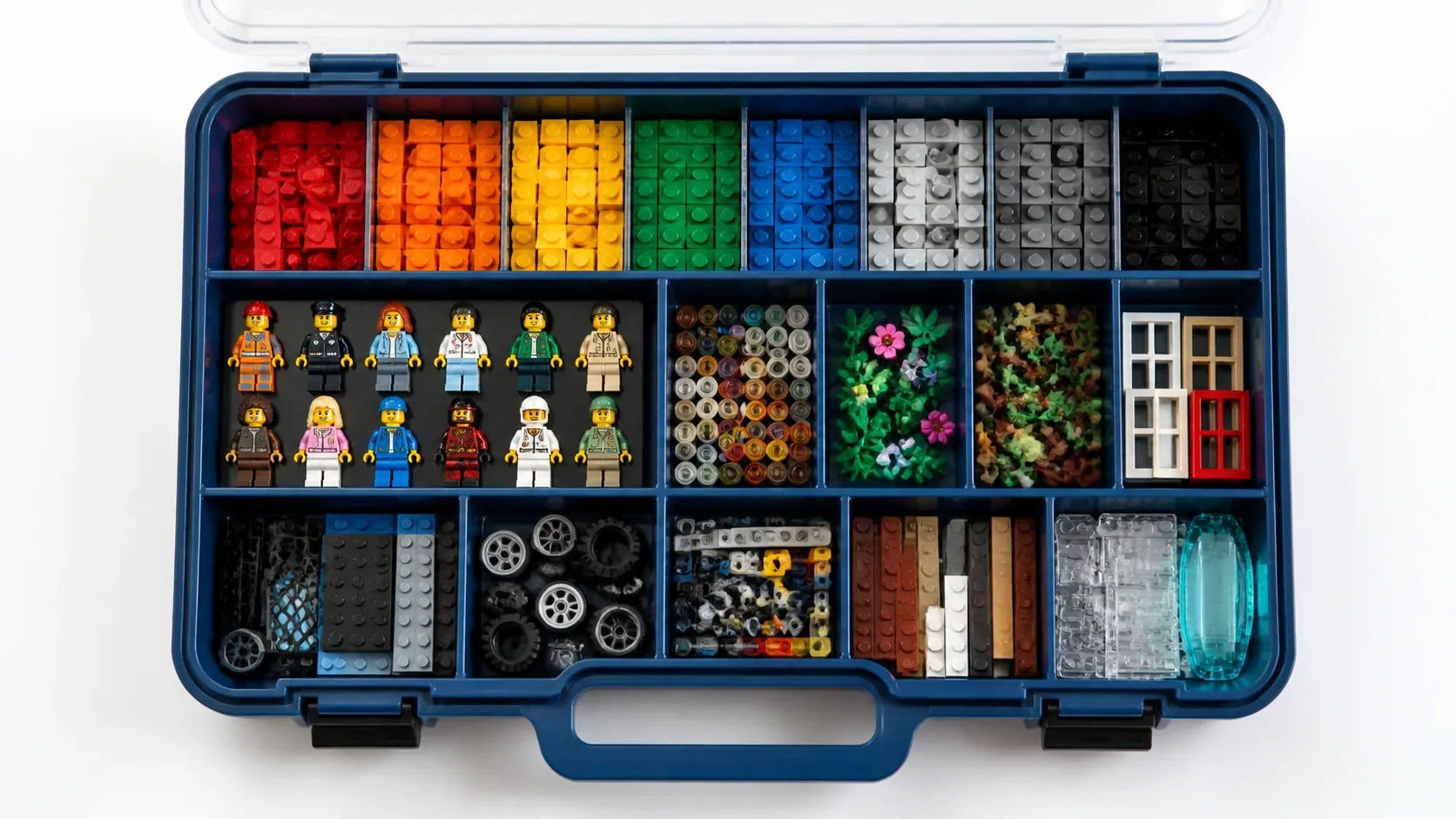
Mixed collections benefit from specialized compartment design. Minifigures need protection from damage and crushing. Small accessories (wheels, connectors, chains) require dedicated drawers to prevent loss. Larger specialty pieces sometimes don't fit standard compartments. Cases with adjustable dividers offer flexibility; fixed compartments force one-size-fits-all solutions.
Considering dust protection and climate control factors
Dust accumulation degrades brick appearance and playability over time. Hard-shell cases with secure latches provide superior dust protection compared to soft-sided organizers. Climate considerations matter for long-term storage—extreme heat warps plastic cases, while high humidity encourages moisture buildup inside sealed compartments. Assess your storage environment's temperature stability and moisture levels.
BrickZoneHub Storage Case Capacity Tiers and What They Hold
Compact cases (200–500 pieces): ideal for travel, gift sets, and beginner collections
Compact cases serve travelers, kids with starter sets, and builders managing single-theme collections. These lightweight organizers slip into backpacks or car seats without burden. They typically feature 4–8 compartments. The trade-off: capacity limits prevent storing comprehensive collections. Perfect for taking to a friend's house or managing one specific LEGO theme, but insufficient for serious collectors.
Medium organizers (500–2,000 pieces): sweet spot for casual builders and growing collections
Medium cases represent the optimal balance for most casual builders. This tier accommodates several completed sets plus miscellaneous pieces acquired over time. Most feature 8–15 compartments with mixed sizes, addressing different piece categories. Portability remains reasonable—still manageable for carrying to events or storing in closets. This capacity tier dominates the market because it solves real problems for average builders without excessive bulk.
Large multi-tier solutions (2,000–5,000+ pieces): designed for serious collectors and mixed-theme storage
Large cases appeal to collectors maintaining multiple themes, competitive builders, and educators managing classroom sets. These multi-tier organizers feature 20+ compartments across stacked sections. Capacity far exceeds casual builder needs but proves necessary for comprehensive collections. The drawback: weight and bulk make frequent transport impractical. These cases demand dedicated storage locations but provide unmatched organization potential.
Understanding the relationship between case dimensions and actual usable brick volume
Not all capacity is created equal. A case claiming 2,000-piece capacity might feature awkwardly sized compartments that waste space or create dead zones. Rectangular compartments fill efficiently; circular or irregular shapes waste volume. Case interior dimensions don't translate directly to usable storage—compartment configuration matters as much as overall size. Examine compartment layouts carefully rather than relying solely on theoretical capacity numbers.
How compartment configuration affects real-world storage efficiency versus theoretical capacity
A case with uniform small compartments excels at organizing small pieces but leaves large pieces underutilized. Conversely, cases with only large compartments struggle organizing small elements. The best designs balance compartment sizes based on typical piece distribution in LEGO collections. Mixed compartment configurations maximize real-world efficiency even if theoretical capacity numbers look identical between different models.
Comparing stacking capabilities for builders managing multiple cases
Collectors often need multiple cases. Stackable designs save storage space and improve organization. Cases with reinforced bottoms and flat tops stack securely without damaging compartments. Non-stackable cases sprawl across shelves, consuming valuable real estate. If you anticipate needing multiple cases, prioritize stackability during purchase to avoid storage headaches later.
Weight distribution and handling comfort when cases reach maximum capacity
Full cases become heavy—potentially 15–25 pounds depending on capacity and brick density. Poorly designed handles create strain during carrying. Look for handles positioned to distribute weight comfortably, ideally with ergonomic padding for extended carrying. Weight distribution across the case bottom prevents tipping and damage to compartments. Lightweight materials matter more for frequently transported cases; weight matters less for stationary storage.
Explore BrickZoneHub cases and find your ideal storage solution now.
Essential Features That Separate Quality Cases from Budget Options
Hard-shell versus soft-sided construction and durability trade-offs
Hard-shell cases protect contents from external pressure and impact. They resist warping, maintain shape under stacked weight, and safeguard valuable pieces from crushing. Soft-sided organizers weigh less and compress into tight spaces, but offer minimal protection during rough handling or stacking. Hard-shell construction costs more but delivers superior long-term durability for collections stored or transported frequently.
Removable compartment systems and their impact on organization flexibility
Fixed compartments force predetermined organization schemes. Removable compartments adapt to changing collection needs—reorganize when acquiring new piece types or adjusting organizational systems. Some cases feature trays that pop out entirely, providing temporary workspace during building sessions. This flexibility adds value, especially for growing collections with unpredictable composition.
Adjustable dividers: why customization matters for different piece sizes
Adjustable dividers transform a case into multiple configurations. Small dividers accommodate sorted colors or piece types; larger sections handle specialty pieces or minifigure storage. Cases lacking adjustable dividers force compromises—either oversized compartments wasting space or undersized compartments squishing large pieces. Truly customizable systems justify their cost through adaptability across changing collection needs.
Clear plastic sections and transparent compartments for quick visual identification
Opaque compartments require opening and searching to locate specific pieces. Transparent sections let you spot colors and piece types instantly, accelerating building sessions. Not all compartments need transparency—mixing clear and opaque sections balances visibility with cost. Tinted clear plastic reduces glare and provides aesthetic appeal while maintaining identification benefits.
Secure latch mechanisms, zipper quality, and long-term reliability considerations
Budget cases feature cheap latches that break after months of regular use. Quality latches survive years of opening and closing without degradation. Zippers matter equally—flimsy zippers jam, misalign, or break under stress. Test latches and zippers before purchasing when possible. Read reviews specifically mentioning durability over time; initial quality sometimes differs from long-term performance.
Reinforced handles and ergonomic design for frequent travelers and young builders
Handles endure stress during frequent carrying. Single-point handles concentrate force; dual handles distribute weight evenly. Ergonomic padding prevents hand fatigue. For young builders, consider handle accessibility—can children comfortably grasp handles sized for adult hands? Cases designed for kids feature smaller, softer handles. Adult-focused cases often overlook ergonomics until you're carrying them regularly.
Water-resistant materials and protective padding for safeguarding valuable pieces
Water resistance protects against spills, rain during outdoor events, and humid storage environments. Not true waterproofing—water-resistant materials resist moisture penetration without full sealing. Protective padding inside cases prevents brick scratching and damage during transport. Quality interior lining protects both the case and its contents from wear.
Interior lining quality and how it prevents brick scratching and dust accumulation
Rough plastic interiors scratch bricks and reduce luster, especially problematic for valuable minifigures and specialty pieces. Smooth lining or fabric-lined interiors prevent scratching while resisting dust accumulation. Higher-quality lining also resists tears and degradation, maintaining protective qualities across years of use. Cheap cases skip interior protection, resulting in dulled bricks and accumulated dust.
Portability and Travel Considerations for Mobile Builders
Lightweight construction benefits for kids, parents, and convention-going collectors
Lightweight cases make sense for anyone carrying their collection beyond their home. Kids struggle with heavy cases, limiting where they can take their collections. Parents tired of carrying heavy loads appreciate lighter alternatives. Convention-goers benefit from reduced fatigue during lengthy events. Weight matters most for frequent travelers; weight barely impacts stationary storage cases.
Carry handle design and comfort during extended transport
Extended carrying reveals handle design flaws. Thin handles cut into hands; poorly positioned handles create awkward weight distribution. Wide, padded handles distribute pressure across your palm comfortably. Some cases feature side handles in addition to top handles, improving maneuverability in tight spaces. Test handle comfort before purchasing if possible—uncomfortable carries become obvious during convention days.
Stackability features for families managing multiple cases in vehicles or storage areas
Families with multiple builders accumulate multiple cases. Stackable designs fit efficiently in vehicles during road trips or convention travel. Non-stackable cases sprawl across back seats, consuming space needed for passengers. Secure stacking prevents cases from sliding or tipping during acceleration and braking. Stackability also matters for home storage—vertical stacking saves valuable closet or shelf space.
TSA compliance and airline-friendly dimensions for traveling with collections
Travelers flying with collections should verify case dimensions match TSA carry-on regulations. Standard carry-on dimensions run approximately 22 × 14 × 9 inches. Compact and medium cases typically fit these limits; large cases usually exceed them. Soft-sided organizers compress slightly, sometimes fitting into carry-on space where hard cases would exceed limits. Check specific airlines' policies—dimensions vary slightly between carriers.
Weather-resistant properties for outdoor building sessions and backyard storage
Outdoor builders need cases protecting contents from rain, direct sunlight, and temperature fluctuations. Sealed cases with weather-resistant materials prevent moisture intrusion during sudden downpours. UV-resistant materials slow plastic degradation from extended sun exposure. Weather resistance particularly matters for collectors storing cases in garages, sheds, or outdoor structures lacking climate control.
Durability testing: which cases withstand drops, bumps, and rough handling
Convention floors are unforgiving. Cases get dropped, bumped against walls, and stacked with other gear. Quality cases survive rough handling without compartment damage or latch failure. Budget cases show cracks, separated corners, and broken latches after rough events. Read reviews specifically mentioning durability through multiple uses; initial quality doesn't guarantee long-term resilience.
Compact footprint when empty for space-efficient storage between building sessions
Cases occupy storage space whether full or empty. Compact cases stored empty take minimal space. Large cases remain bulky even when empty, consuming valuable closet or shelf real estate. For builders with limited storage space, compact cases offer advantages beyond portability—they don't command storage space during inactive periods.
Price Range Breakdown: Finding Value at Every Budget Level
Entry-level cases ($20–$30): what features you gain and what you sacrifice
Budget cases solve basic storage needs at minimal cost. Expect simple compartment systems, basic latches, and limited capacity. Protection suffers compared to premium models—rough handling damages budget cases more easily. Materials feel less durable; zippers and latches might fail after months of regular use. Best suited for casual builders with small collections or temporary storage needs.
Mid-range organizers ($30–$45): the optimal balance of capacity, durability, and price
Mid-range cases represent the popular choice for good reason. Capacity accommodates most casual builder collections. Materials and latches prove durable across years of use. Compartment configurations balance organization flexibility with reasonable cost. Features like removable trays or adjustable dividers appear at this level. This tier delivers reliability without premium pricing—solid investments for serious casual builders.
Premium solutions ($45–$60+): specialized features and materials worth the investment
Premium cases justify higher costs through superior materials, specialized compartments for minifigures and accessories, multi-tier designs, and exceptional durability. These cases often feature brand reputation backed by customer service and warranty support. Collectors protecting valuable pieces and serious builders attending multiple events find premium cases worthwhile. The investment pays dividends through years of reliable protection.
Understanding cost-per-brick-capacity as a value metric
Compare value across tiers using cost-per-brick capacity. A $30 case holding 1,500 pieces costs $0.02 per piece of capacity. A $50 case holding 3,000 pieces costs $0.017 per piece. Cost-per-capacity often improves at higher tiers, though other factors (durability, portability) might justify budget options despite lower efficiency.
Seasonal sales, bundle deals, and where to find the best pricing
LEGO-adjacent products see sales during holiday seasons and back-to-school periods. Multi-case bundle deals offer discounts when buying several cases. Online retailers sometimes undercut physical stores. Patience pays dividends—cases rarely increase in price, so waiting for sales stretches budgets. Track prices using price-monitoring tools to catch deals on preferred models.
Long-term cost analysis: cheaper cases requiring replacement versus durable investments
A $25 case failing after 18 months costs $25. Replacing it with another $25 case costs another $25, totaling $50 over three years. A $45 case surviving five years costs $45 total—better long-term value despite higher initial purchase. Calculate expected lifespan and replacement frequency when comparing options. Quality cases often prove cheaper across their entire usable lifetime.
Warranty coverage and customer support differences across price tiers
Budget cases often lack warranties or offer limited coverage. Mid-range cases typically include 1–2 year warranties. Premium cases sometimes feature lifetime warranties with responsive customer service. Warranty coverage reflects manufacturer confidence in durability. For significant investments, strong warranty support provides peace of mind and recourse if premature failure occurs.
Organization Strategies That Maximize Your Storage Case Efficiency
Color-sorting systems and why they accelerate building time
Color-sorted collections speed up brick identification during building sessions. Locating a specific red slope becomes instant instead of searching through mixed compartments. This system requires more compartments but delivers massive time savings for active builders. Color-sorting works best for medium-to-large collections where piece quantity justifies dedicated compartments per color.
Categorizing by piece type (bricks, plates, slopes, specialty pieces) for logical access
Organizing by function matches building workflows. Bricks, plates, and slopes group together logically since builders often need combinations of these pieces. Specialty pieces (wheels, connectors, hinges) deserve dedicated compartments, preventing loss and enabling quick access. Type-based organization reduces building interruptions from searching through incompatible piece categories.
Minifigure storage solutions within compartments to prevent damage
Minifigures represent valuable collection elements deserving dedicated protection. Soft compartments or padded sections prevent head, arm, and leg breakage. Separating minifigures from bricks prevents crushing damage. Some collectors store minifigures in clear compartments for display appeal. Regardless of method, dedicated minifigure storage prevents the common problem of lost or damaged figures.
Accessory organization: separating wheels, connectors, and small elements
Small accessories slip through gaps in brick compartments, causing permanent loss. Dedicated drawers with fine mesh or separate tiny compartments prevent escape. Clearly labeled sections help family members locate needed accessories. Organized accessories accelerate building sessions—finding the right connector doesn't require dumping entire compartments.
Creating a brick inventory system to track what you own and what you're missing
Digital inventories (spreadsheets or apps) track brick counts, colors, and piece types. Physical inventory labels inside cases remind you of compartment contents. Inventory systems identify missing pieces needed for specific sets and reveal collection gaps. This organization transcends storage case efficiency but integrates naturally with organized collections.
Labeling compartments for family members and collaborative building sessions
Labels guide kids and collaborators toward correct compartments, preventing disorganization. Color-coded labels, numeric systems, or descriptive tags work depending on preference. Clear labeling maintains organization across shared collections and multiple users. Laminated labels resist wear from frequent handling.
Rotation strategies for active building projects versus archived sets
Active building projects benefit from front-facing compartment access. Archived sets stored long-term can occupy less accessible positions. Rotating organization schemes based on project activity maintains quick access to current-use pieces while accommodating inactive collections. This flexibility adapts to changing building habits.
Common Limitations and How to Work Around Them
Capacity constraints when collections exceed case maximums and expansion solutions
Collections outgrowing single cases require expansion. Purchasing multiple cases addresses this through distributed storage. Modular systems stack cases, maintaining organized compartmentalization across units. Some collectors rotate active collections through single cases rather than maintaining all pieces simultaneously. Understanding expansion options prevents purchasing cases that quickly become inadequate.
Bulkier dimensions of larger cases and creative storage placement strategies
Large cases occupy significant floor or shelf space. Vertical storage solutions like wall-mounted shelves or closet organization systems accommodate large cases efficiently. Under-bed storage slides cases out of sight. Creative placement in closets, garage shelves, or dedicated storage areas manages bulky organizers without consuming living space.
Specialty piece accommodation: oversized elements that don't fit standard compartments
Large plates, platform pieces, and specialty elements don't fit standard compartments. Dedicated sections with larger dimensions accommodate these pieces. Some collectors store oversized elements separately or modify compartments to fit specialty pieces. Understanding piece composition helps anticipate accommodation needs before purchasing.
Ventilation considerations for long-term storage and preventing moisture buildup
Completely sealed cases trap moisture in humid environments, potentially promoting mold or corrosion. Cases with ventilation grilles prevent moisture accumulation while maintaining dust protection. Dry storage environments reduce ventilation urgency. Climate-controlled spaces eliminate moisture concerns even with sealed cases.
Compartment rigidity and whether adjustable dividers truly offer flexibility
Adjustable dividers sometimes resist repositioning or fail to hold position. Quality dividers slide smoothly and lock firmly. Testing divider function before purchase prevents frustration with unresponsive systems. Not all adjustable systems deliver promised flexibility—hands-on evaluation matters.
Durability concerns with frequently opened zippers and latches over time
Zippers and latches experience wear proportional to usage frequency. Cases opened daily eventually develop zipper binding or latch failure. Quality mechanisms resist degradation across years of heavy use. Budget cases show wear within months of daily opening. Realistic assessment of usage frequency guides durability expectations.
Heat sensitivity of plastic cases in vehicles and outdoor storage environments
Plastic cases warp under extreme heat, particularly in vehicles parked in direct sunlight. Interior temperatures in closed vehicles regularly exceed 140°F on warm days, warping soft-sided cases. Hard-shell cases resist warping better but still suffer in extreme temperatures. Store cases away from vehicle interiors or use heat-resistant organizers for hot climates.
Comparing BrickZoneHub Cases to Competitor Storage Solutions
How BrickZoneHub stacks against generic plastic organizers and DIY solutions
Generic plastic drawer units lack specialized compartmentalization for LEGO pieces. DIY solutions using household containers rarely offer secure closure, portability, or aesthetic appeal. BrickZoneHub cases provide purpose-built design balancing capacity, protection, and portability. Direct comparison reveals superiority in organization flexibility and construction quality, though DIY solutions cost less initially.
Specialty LEGO storage brands and their unique positioning
Competitor brands offer varying specialization levels. Some focus on compact travel cases; others emphasize display-friendly transparent compartments. Still others target serious collectors with premium materials and extensive capacity. Each brand positions differently—understanding competitive positioning helps identify which brand aligns with your priorities.
Custom-built storage versus off-the-shelf cases: cost and customization trade-offs
Custom-built storage perfectly matches specific needs but requires significant time, materials, and potentially carpentry skills. Off-the-shelf cases cost less and offer immediate usability but require accepting predetermined designs. For most builders, off-the-shelf cases deliver superior value despite customization limitations.
Modular systems that allow expansion versus fixed-capacity single cases
Modular systems stack additional units as collections grow. Fixed-capacity cases require purchasing entirely new organizers when outgrown. Modular systems offer long-term scalability but typically cost more per unit. Fixed-capacity cases cost less but potentially need replacement rather than expansion.
Brand reputation, customer reviews, and long-term reliability data
Established brands often deliver consistent quality backed by customer reviews documenting real-world durability. Newer brands lack long-term reliability data. Reading verified customer reviews reveals common failure points, actual capacity performance, and user satisfaction. Reputation reflects years of user experience synthesized into reliability confidence.
Warranty and return policies across different manufacturers
Comprehensive warranties indicate manufacturer confidence in durability. Generous return policies protect buyers from purchasing disappointment. Comparing warranty terms and return windows separates brands standing behind products from those offering minimal customer protection.
Ecosystem benefits: whether cases work with other BrickZoneHub products
Some manufacturers offer complementary products that integrate with primary cases—desk organizers, display stands, or protective covers. Ecosystem thinking provides long-term flexibility for expanding beyond basic storage. Brand-specific ecosystem benefits reward staying within manufacturers' product lines.
Real-World Use Cases: Who Benefits Most from This Storage Solution
Parents managing playroom organization and teaching kids responsibility
Parents battling scattered bricks across floors find relief through organized storage. Cases teach children responsibility for maintaining collections. Organized systems reduce cleanup time and prevent lost pieces. Parents appreciate cleaner playrooms and simplified toy management through dedicated storage.
Serious collectors protecting valuable minifigures and rare pieces
Collectors maintaining valuable inventories need superior protection. Specialized compartments protect rare minifigures from damage. Organized systems track valuable pieces, preventing loss. Serious collectors view storage cases as insurance protecting significant investments.
LEGO enthusiasts attending conventions, competitions, and building meetups
Convention-goers need portable collections showcasing building ability. Organized cases enable showcasing specific themes or specialty collections. Easy transport to events matters as much as home storage for active hobbyists.
Gift-givers seeking practical presents for builders of all ages
Storage cases solve universal LEGO problems, making practical gifts for builders at any level. Combining cases with new sets creates comprehensive gift packages. Storage solutions acknowledge the recipient's collection maturity while providing continued utility.
Teachers and educators organizing classroom LEGO sets for group projects
Educational LEGO sets require organization enabling classroom distribution and collection. Cases organize class materials for efficient instruction. Durable cases withstand heavy classroom use across years of projects.
Moving and relocation scenarios where protection and portability matter
Moving collections between homes demands organization and protection. Cases secure pieces during transport, preventing loss. Organization during moves enables quick home reconstruction. Portable organization proves invaluable during residential transitions.
Rental properties and shared spaces requiring portable, secure storage
Shared living situations benefit from personal storage containing collections securely. Portable cases enable quick removal if relocating. Organized, contained storage prevents disputes over shared space usage.
Making Your Final Decision: A Selection Checklist
Matching case size to your actual brick count with 20% growth buffer
Calculate current piece count plus anticipated additions over the next year or two. Add 20% buffer accommodating unexpected purchases or gift sets. Match this total to case capacity recommendations. Oversizing prevents frequent reorganization; undersizing creates frustration requiring replacement purchases.
Prioritizing features that align with your primary use case (travel, display, workspace)
Travel-focused builders prioritize lightweight design and portable dimensions. Display-minded collectors seek transparent compartments and aesthetic appeal. Workspace organizers emphasize accessibility and compartment flexibility. Clarity on primary use case eliminates features mattering less to your situation.
Evaluating handle comfort and weight capacity for your specific situation
Test handle comfort if purchasing in-store. Consider anticipated weight when full—will you comfortably carry it? For kids' cases, consider whether young hands can manage carrying. Weight capacity matters less for stationary storage but remains important for frequent transport.
Checking compartment configuration against your organization preferences
Review actual compartment layout rather than theoretical capacity. Count compartments and evaluate sizes against your piece distribution. Verify whether compartments suit your intended organization scheme—color-sorting requires many small compartments; type-based sorting needs fewer but varied sizes.
Verifying durability ratings and customer satisfaction scores
Research actual user reviews mentioning durability over extended periods. Look for mentions of latch or zipper failure, compartment degradation, or construction issues. Long-term reliability matters more than initial impressions. Highly rated cases from established brands reduce purchase risk.
Comparing warranty terms and return policies across retailers
Longer warranties indicate manufacturer confidence. Generous return windows let you test cases at home before committing. Compare warranty coverage—some cover manufacturing defects only; others offer more comprehensive protection. Strong return policies enable risk-free testing.
Testing cases in-store when possible to assess build quality and latch mechanics
Handle cases physically. Test latch operation multiple times—does it engage smoothly? Open zippers fully to verify smooth operation. Assess handle comfort with weight. Inspect compartment construction for flimsy materials. In-store testing reveals quality issues invisible from product photos.
Reading verified customer reviews from builders with similar needs and collections
Seek reviews from builders with comparable collection sizes and use cases. Parents' reviews help parents; convention-goers' reviews help travelers. Verified purchase reviews carry more weight than generic opinions. Specific reviews mentioning relevant features (color-sorting capability, portability, durability) prove most valuable.
Your Path to Brick Organization Starts Here
Selecting the right BrickZoneHub LEGO storage case transforms how you build, organize, and protect your collection. Whether you're a parent tired of stepping on loose bricks, a collector safeguarding valuable minifigures, or a hobbyist traveling to building events, the right organizer delivers peace of mind and efficiency. The investment typically ranges from $20 to $60, but the value extends far beyond the price tag. You'll save countless hours searching for pieces, protect your bricks from damage and dust, and actually enjoy your collection more when everything's organized and accessible.
Start by assessing your current collection size, identifying your primary use case (travel, home organization, or display), and selecting a BrickZoneHub case matching your needs. Calculate your brick count, consider your storage space, and prioritize the features aligning with your situation. Test cases when possible, read authentic customer reviews, and make an informed decision anchored in your specific circumstances rather than marketing claims or arbitrary rankings.
Your building experience depends on quick piece access, safe storage, and organized systems. The right case eliminates frustration from scattered pieces while enabling efficient building sessions. Quality cases deliver years of reliable service, making them durable investments rather than temporary purchases.
Start your organization journey with BrickZoneHub storage solutions today.