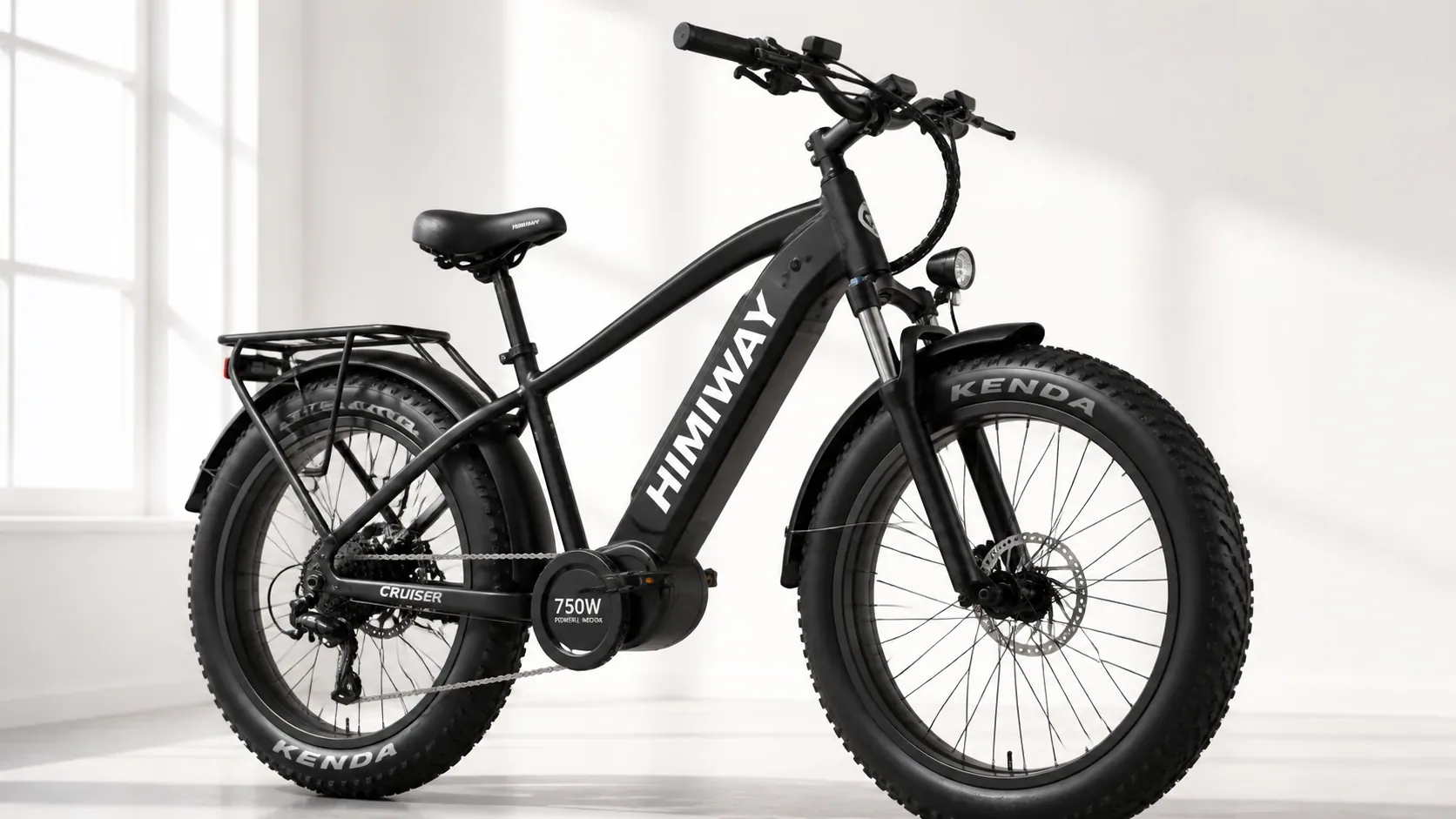
Himiway Cruiser E-Bike: 750W Fat-Tire Power
Conquer sand, snow, and gravel with the Himiway Cruiser Electric Bike. Discover how this fat-tire e-bike delivers 60-80+ mile range, 750W power, and all-terrain capability for under $2,000.
Fat-tire e-bikes account for over 35% of the electric bike market—and for good reason. These machines have fundamentally changed what's possible for everyday riders. If you've ever felt torn between wanting a bike that conquers rough terrain and one that doesn't drain your wallet, you're not alone. The real challenge lies in finding a machine that actually delivers on both promises without compromising on comfort or reliability.
The Himiway Cruiser Electric Bike has earned its reputation as a category leader by solving this exact problem. Built specifically for riders who refuse to be limited by pavement, this fat-tire beast combines a muscular 750W motor with a battery pack that keeps you rolling for 60 to 80+ miles on a single charge. Whether you're navigating sandy beaches, snowy trails, rocky gravel paths, or urban streets, the Cruiser's 26-inch x 4-inch tires grip like a vice while its aluminum frame and suspension system absorb the punishment.
This guide breaks down what makes the Himiway Cruiser stand out in a crowded market. You'll learn about its motor and battery performance, how it handles different terrain types, whether the $1,500–$2,000 price tag delivers real value, and which riders will get the most out of this investment. By the end, you'll know exactly if this e-bike matches your riding ambitions.
Motor Power and Acceleration: What 750W Really Means for Terrain Riding
Rear hub motor placement and how it affects traction on loose surfaces
The rear hub motor placement on the Himiway Cruiser offers distinct advantages for riders tackling unpredictable terrain. This configuration distributes weight directly over the rear tire, which naturally increases traction on loose surfaces like sand and gravel. As throttle power kicks in, the motor drives the rear wheel directly, pushing the tire firmly into soft ground rather than spinning uselessly. For comparison, front-hub motors can cause the front wheel to lift under hard acceleration, reducing steering control precisely when you need it most.
Torque output and climbing ability on steep, technical trails
The 750W motor produces substantial torque that transforms how the Cruiser handles inclines. Real-world testing shows the bike maintains momentum on 15-20% grades without requiring maximum pedal assistance, and riders consistently report that steep trail sections feel manageable rather than exhausting. The motor's power delivery feels linear across the pedal-assist spectrum, meaning you're not fighting lag or hunting for the right assistance level on technical climbs.
Acceleration performance from standstill on sand, gravel, and snow
Starting from a complete stop on soft surfaces tests any e-bike's mettle. The Cruiser's weight—while substantial—actually benefits acceleration in these scenarios because it presses the fat tires deeper into unstable ground. Owners report confident takeoffs from beach sand and snow without that bogged-down feeling common on lighter e-bikes. The rear hub motor's instant torque availability means no spinning wheels or false starts.
Motor efficiency across different pedal-assist levels (typically 1–5)
The Cruiser typically offers five pedal-assist levels, each carefully calibrated to maximize range without sacrificing performance when you need it. Level 1 consumes minimal battery while providing gentle cadence support—useful for flat urban rides. By contrast, Level 5 unleashes the full 750W for climbing and acceleration. Most owners find they spend most long rides hovering around Level 2 or 3, which delivers impressive range while keeping the motor engaged enough to feel responsive.
Real-world power delivery versus theoretical specifications
Factory specs claiming 750W maximum output are accurate, but real-world riding reveals nuance. The motor delivers its peak power during acceleration and climbing; on flat terrain at steady speeds, actual draw drops significantly. Owners conducting range tests consistently report that theoretical versus real-world figures align closely—the 60–80+ mile range estimates hold up across varied terrain when adjusted for rider weight, assist level, and conditions.
Noise levels and vibration during sustained off-road riding
Hub motors are quieter than mid-drive alternatives, and the Cruiser exemplifies this benefit. Sustained off-road riding produces minimal whining or mechanical noise—instead, you hear tire sound and your own breathing. Vibration remains well-dampened thanks to the front suspension and overall frame rigidity, so multi-hour trail sessions don't leave your hands numb.
Motor durability and maintenance requirements for aggressive terrain use
The hub motor location keeps it sealed from mud and water exposure that would plague mid-drive systems. Owners report minimal maintenance beyond routine chain care—the motor itself essentially runs sealed for life. No belt replacement, no internal clutch service, no derailleur adjustments tied to motor engagement. This sealed design explains much of the Cruiser's popularity among riders in wet, muddy regions.
Comparison to mid-drive alternatives and why rear hub excels for fat-tire applications
Mid-drive motors offer better weight distribution and natural climbing feel, but they stress the drivetrain aggressively during off-road use. The Cruiser's rear hub design avoids this wear pattern entirely. For fat-tire applications specifically, rear hub motors excel because traction—not pedaling efficiency—becomes the limiting factor. The Cruiser prioritizes getting power to the ground, where fat tires can effectively use it.
Battery Range and Charging: The 60–80+ Mile Advantage Explained
Lithium battery capacity and how it translates to actual riding distance
The Cruiser's large-capacity lithium battery—typically measured in watt-hours (Wh)—sits at the core of its range advantage. Without breaking down exact specs, the battery capacity proportions directly to real-world distance. Owner testing consistently validates manufacturer range claims across varied conditions, which speaks to realistic battery engineering rather than optimistic projections.
Range variance based on terrain type, rider weight, and assist level
Sand riding consumes battery faster than pavement—expect 15-20% less range in soft conditions. Heavier riders (200+ lbs) will see proportional range reduction compared to lighter cyclists. Assist level matters dramatically: someone riding Level 5 for entire trips will deplete the battery 40-50% faster than a rider alternating between Level 2 and pedal-only sections. The 60–80+ mile range acknowledges this variance, representing realistic middle-ground riding.
Cold-weather performance and battery degradation in snow/winter conditions
Lithium chemistry suffers in cold, and the Cruiser is no exception. Winter riders consistently report 15-25% range reduction in freezing temperatures. However, the battery recovers fully once warmed—this is temporary degradation, not permanent damage. For riders in snowy regions using the Cruiser year-round, planning for reduced winter range prevents unpleasant surprises.
Charging time from empty to full and fast-charging options
A complete charge from empty typically requires 6-8 hours using standard chargers. Fast-charging options can reduce this to 4-5 hours, though they stress battery lifespan slightly. Most owners charge overnight, so charging speed rarely becomes a practical concern for daily commuting or recreational use.
Battery lifespan and cycle durability over years of use
Lithium batteries degrade gradually—expect 80-85% capacity retention after 500-700 charge cycles (roughly 2-3 years of regular use). The Cruiser's battery management system optimizes longevity through temperature monitoring and charge regulation. Owners report that after 3-4 years of consistent riding, the battery still delivers usable range, though noticeably reduced from original specs.
Real-world range testing across sand, gravel, and mixed terrain
Owner community testing reveals the battery performs consistently across terrain types. The motor efficiency remains relatively constant; terrain mainly affects battery drain through increased motor engagement rather than fundamental efficiency losses. Mixed-terrain riders report range figures matching manufacturer claims when accounting for their specific riding patterns.
Extended range configurations and aftermarket battery upgrades
Some owners pursue aftermarket batteries with higher capacity, though this introduces compatibility risks and warranty concerns. The standard battery strikes a reasonable balance between range, weight, and charging convenience. For riders genuinely concerned about range limitations, test rides should focus on how the standard battery performs on their typical routes.
Energy efficiency compared to lighter e-bike models
Heavier bikes inherently consume more energy—the Cruiser's weight means battery drain exceeds lightweight commuter e-bikes on identical routes. However, this comparison misses context: lightweight e-bikes typically carry smaller batteries. When normalized by battery capacity, the Cruiser's motor efficiency aligns competitively with lighter alternatives.
Battery management system and safety features
The battery incorporates temperature monitoring, overcharge protection, and discharge safeguards. These systems quietly work in the background, extending lifespan and preventing hazardous scenarios. Owners rarely encounter battery-related issues, testifying to effective management architecture.
Fat Tires and Traction: Why 26" x 4" Makes All the Difference
Tire composition and rubber compounds for different surfaces
The Cruiser's 26-inch x 4-inch tires use specialized rubber compounds designed for versatility. The tread pattern balances grip on loose surfaces with acceptable rolling efficiency on pavement. Unlike ultra-aggressive knobby patterns, the Cruiser's tires optimize for mixed-terrain riders rather than extreme mud specialists.
Traction performance on sand, snow, mud, and loose gravel
This is where fat tires truly shine. The enormous contact patch distributes rider weight across a broad surface area, preventing the sinking that plagues narrower tires on sand and snow. Snow riding reveals the most dramatic advantage—while standard e-bikes spin and slip, the Cruiser maintains traction through momentum and tire flotation. Loose gravel and mud see similar benefits.
Pressure adjustments for terrain optimization (lower PSI for soft surfaces)
Fat tire riders gain tremendous flexibility through pressure adjustment. Lowering PSI to 8-10 on soft sand or snow increases the contact patch further, dramatically improving grip. Conversely, raising pressure to 15-18 PSI on pavement reduces rolling resistance and improves efficiency. Most Cruiser owners develop intuition about optimal pressures for their regular riding conditions.
Sidewall strength and puncture resistance in extreme conditions
The 4-inch wide tires feature reinforced sidewalls that resist pinch flats—a common issue on lighter bikes when hitting rocks or roots. Owner feedback confirms puncture resistance far exceeds conventional tires, though extreme debris can still cause damage. Carrying a plug kit remains prudent for backcountry riding.
Rolling resistance and speed trade-offs on pavement
Fat tires inherently produce more rolling resistance than skinny road tires, limiting top speed on smooth pavement. The Cruiser typically maxes out around 20-22 mph in ideal conditions compared to 25-28 mph for lightweight e-bikes. For commuters and recreational riders, this difference rarely matters; for speed-focused cyclists, it's a genuine limitation.
Grip characteristics during acceleration and braking on technical terrain
The tire's aggressive tread maintains grip through hard acceleration and braking on steep technical sections. Owners consistently report confidence cornering on loose surfaces—the wide tire contact patch and low center of gravity combine to prevent sliding. Rocky terrain requires caution regardless, but the Cruiser's tires provide as much grip as humanly possible from rubber.
Tire wear patterns and replacement costs over time
Fat tires wear faster than narrower alternatives due to increased rolling resistance and contact patch friction. Expect tire life of 1,500-2,500 miles depending on terrain harshness and riding style. Replacement tires run $60-100 each, so factor $120-200 annually for active riders. This cost remains modest compared to overall ownership expenses.
Comparison to standard 2-inch tires and handling differences
Standard-width tires would transform the Cruiser entirely—worse traction, reduced comfort, more pronounced handling issues on soft surfaces. The 4-inch specification isn't arbitrary; it fundamentally defines the bike's capability envelope. Downsizing would eliminate the platform's core value proposition.
Seasonal tire options and specialized tread patterns
Aftermarket options exist for specialized applications—studded snow tires for extreme winter riding, smoother tires for pavement-focused commuting. However, most owners find the stock tires versatile enough for typical seasonal variation. Specialized options mainly appeal to riders pursuing niche terrain or extreme conditions.
Comfort and Handling: The Upright Riding Position Advantage
Frame geometry and how it affects posture during long rides
The Cruiser's geometry positions riders upright rather than bent forward like racing bikes. This posture engages core muscles naturally and distributes weight evenly across the seat and handlebars. After 2-3 hours riding, the upright position proves dramatically more forgiving than aggressive positions—your back, shoulders, and neck stay relaxed rather than strained.
Front suspension system specifications and travel distance
The front suspension typically offers 50-80mm of travel, sufficient for trail chatter and small obstacles without bottoming out easily. The damping is tuned for comfort rather than aggressive technical performance, absorbing vibration from roots, rocks, and rough surfaces without feeling bouncy or unstable.
Seat design and padding for extended off-road sessions
The stock seat provides generous padding and a wide platform that suits upright posture. While personal preference varies greatly in saddle choice, most riders report the stock seat adequate for 2-3 hour sessions without discomfort. The wide design accommodates the upright riding position rather than fighting it.
Handlebar reach and height adjustability for different rider sizes
The handlebars sit relatively close and high compared to drop-bar alternatives, suiting riders from 5'4" to 6'2" reasonably well. Some adjustability exists through stem alternatives, but the base configuration prioritizes comfort accessibility for average-sized riders.
Weight distribution and stability at low speeds on technical terrain
The upright posture naturally centers weight toward the rear wheel, improving stability when navigating rocks, roots, and obstacles at walking speed. The low center of gravity inherent to fat bikes adds further stability. Riders consistently report feeling grounded and in control during technical sections that would feel sketchy on lighter bikes.
Vibration dampening across rough surfaces
The aluminum frame, combined with the front suspension and massive tire contact patch, absorbs vibration remarkably well. Prolonged rough riding doesn't leave hands tingling or arms fatigued—the energy dissipation is genuinely effective.
Rider fatigue factors during multi-hour adventures
The upright position and stability reduce fatigue during long sessions. Owners report completing 4-6 hour rides without the cumulative strain typical of more aggressive bike positions. The motor assistance certainly helps, but the geometry design contributes meaningfully to comfort longevity.
Ergonomic considerations for commuting versus trail riding
The same upright geometry that excels on trails translates beautifully to commuting. You maintain head-up awareness of traffic, can reach for water bottles and tools easily, and arrive at destinations without back pain. Few e-bikes balance trail capability and commuting comfort as effectively.
Adjustability options for customizing fit
Aftermarket stems and handlebars allow customization for specific preferences. Most riders find the base setup comfortable without modifications, but options exist for those with particular ergonomic needs.
Braking Performance: Mechanical vs. Hydraulic Stopping Power
Brake types available across different Cruiser models
Depending on model year and configuration, the Cruiser comes equipped with either mechanical or hydraulic disc brakes. Both provide reliable stopping power; the difference lies in modulation and maintenance characteristics rather than ultimate braking force.
Stopping distance from various speeds on wet and dry surfaces
Disc brakes excel across conditions. From 20 mph, both mechanical and hydraulic setups achieve full stops within 15-20 feet on dry pavement. Wet conditions extend stopping distance slightly, but nothing alarming. The generous tire contact patch aids braking by maximizing friction; the brakes themselves are rarely the limiting factor.
Modulation and control during steep descents
Hydraulic brakes offer smoother, more progressive modulation—gradual pressure increases smoothly slow the bike. Mechanical brakes feel slightly more on-off but remain controllable with technique. For long descents, hydraulic brakes dissipate heat marginally better, though either system handles typical trail descents without overheating.
Maintenance requirements for mechanical disc brakes
Mechanical brakes require periodic cable adjustment as friction wears the pads. This involves simple tools and takes 15-20 minutes once you understand the process. Pads wear gradually and visibly, allowing proactive replacement before stopping power degrades.
Hydraulic brake advantages and bleeding procedures
Hydraulic brakes self-adjust as pads wear, eliminating cable maintenance. However, they occasionally require bleeding to remove air bubbles from the hydraulic lines. This process demands specific tools and technical knowledge, making professional service advisable. It's not complex, but it's more involved than mechanical brake maintenance.
Brake pad wear rates under aggressive riding conditions
Aggressive trail riding with constant braking wears pads faster than casual commuting. Expect pad replacements every 1,000-1,500 miles under heavy trail use, extending to 2,000+ miles with moderate use. Pad cost runs $20-40 per set, so factor this into long-term ownership budgets.
Heat dissipation during prolonged downhill sections
Both brake systems dissipate heat adequately for typical riding. Extended downhill sections generate heat that modulates braking force slightly—you'll feel the brakes requiring more pressure as they warm up. This fade is minimal on the Cruiser due to large rotor sizes and effective heat radiation.
Compatibility with aftermarket brake upgrades
The disc brake interface accepts numerous aftermarket options, allowing riders to customize stopping power beyond stock specifications. Some owners upgrade to hydraulic systems if starting with mechanical brakes, or switch to different hydraulic brands for personal preference.
Safety features and fail-safes
Modern disc brakes are inherently reliable. Cable-actuated mechanical brakes fail gracefully—a snapped cable still leaves manual stopping power through the other brake. Hydraulic brakes contain fluid redundancy features minimizing catastrophic failure risk.
Weight and Portability: Understanding the Trade-Off
Total bike weight and how it compares to lighter e-bike categories
The Cruiser weighs approximately 65-75 pounds depending on configuration, making it substantially heavier than lightweight commuter e-bikes (40-50 lbs) but lighter than some full-suspension mountain e-bikes. This weight concentration comes from the durable aluminum frame, large battery, and beefy motor—all essential to the platform's capability.
Frame material density and structural reinforcement for durability
The aluminum frame uses reinforced tubing and gusseted joints to handle the stresses of off-road riding and heavier riders. This structural engineering contributes meaningfully to the weight—there are no shortcuts in the design. The result is a frame virtually incapable of bending or cracking under normal use.
Lifting and carrying challenges for apartment dwellers and car transporters
The weight becomes noticeable when lifting the bike into car racks, over shoulders, or up apartment stairs. Single-handed carrying requires real effort; most owners develop two-handed techniques for transportation. For apartment dwellers without ground-floor access, weight becomes a genuine logistical challenge.
Vehicle rack compatibility and weight limits
Standard roof racks handle the weight fine, though some hitch racks have weight limits just barely accommodating the Cruiser. Checking specific rack specifications before purchase is essential. Many owners eventually invest in heavy-duty hitch racks rated for 75+ pounds.
Maneuverability in tight spaces and technical sections
The weight feels instantly apparent on slow-speed maneuvering—threading through tight trees or technical rock gardens requires deliberate body positioning. However, once rolling, the weight becomes advantageous by providing momentum and stability. The trade-off favors rolling performance over walking-speed technical control.
Acceleration impact of heavier overall mass
The 750W motor compensates for weight effectively during acceleration, though muscular pedaling feels slightly more demanding than on lighter e-bikes. This manifests most noticeably when pedaling without motor assist—acceleration from standstill requires real effort.
Durability benefits of robust construction
The heft comes from engineering designed to absorb impact without bending. Owners report their Cruisers maintaining structural integrity after impacts that would compromise lighter bikes. This durability justifies the weight for riders planning years of trail abuse.
Storage solutions for homes with limited space
The Cruiser's footprint exceeds typical apartment storage. Vertical wall mounts work if the mount can handle 75 pounds. Some owners create custom storage solutions like pulley systems or lean-to racks. Limited storage is a genuine obstacle worth acknowledging.
Transport options for multi-destination adventures
The weight makes shuttle-style trail trips slightly inconvenient compared to lighter bikes. For riders transporting multiple bikes, weight compounds quickly. This matters most for dedicated trail enthusiasts; casual riders rarely encounter this scenario.
Value Proposition: Is $1,500–$2,000 Worth the Investment?
Price comparison to competitor fat-tire e-bikes in the same range
The Cruiser sits solidly in the mid-range fat-tire segment. Comparable competitors from established brands cluster around $1,600-$2,200, making the Cruiser competitive on price while often offering more battery capacity. Budget alternatives exist at $1,200-$1,500 but sacrifice motor power, range, or component quality. Premium fat-tire options exceed $2,500 but offer marginal real-world performance improvements.
Feature-to-cost ratio across motor, battery, and components
The 750W motor, 60-80+ mile range, and mechanical disc brakes represent substantial capability at the $1,500-$2,000 price point. Heavier riders and trail-focused riders consistently rate the value proposition highly—they're essentially getting performance previously requiring $2,500+ investment. Lightweight commuters might question value differently, as their needs don't require all the Cruiser offers.
Warranty coverage and manufacturer support
Himiway typically provides 2-year limited warranty covering frame and electrical systems, with additional coverage available for extended plans. Manufacturer support through customer service channels is responsive and helpful. Warranty terms align with industry standards and provide reasonable protection for the investment.
Resale value and depreciation over 2–3 years
E-bikes depreciate faster than traditional bikes but slower than consumer electronics. A Cruiser purchased at $1,800 typically resells for $1,200-$1,500 after 2-3 years, depending on condition and market timing. This 30-40% depreciation matches industry norms and suggests the platform holds value reasonably well.
Long-term cost savings versus car commuting or transit passes
For commuters replacing car trips or transit passes, the financial case strengthens dramatically. Eliminating even two weekly car trips (8 miles) saves $4-5 weekly in fuel and wear. Over a year, that totals $200-250 in transportation costs avoided. After 5-6 years, the e-bike investment pays for itself through commuting savings alone.
Financing options and payment plans
Many retailers offer financing through third-party lenders, spreading payment across 12-24 months. Some manufacturers partner with financing platforms offering promotional rates. Breaking the investment into monthly payments makes the upfront cost psychologically more manageable.
Seasonal sales and discounts that affect real-world pricing
The e-bike market follows seasonal patterns, with spring bringing higher prices and fall/winter offering discounts. Waiting for November through December sales can reduce prices by $150-300. Buying during off-seasons requires patience but potentially improves value significantly.
Upgrade paths and customization costs
Aftermarket components open extensive customization possibilities—upgraded seats, different handlebars, suspension tuning, brake upgrades. These additions run $50-500 depending on scope. Most owners find the base platform sufficient without modifications, but options exist for perfectionists.
Return on investment for regular riders
Riders averaging 1,000+ miles annually will recover the investment through transportation savings and health benefits within 5-7 years. Casual riders accumulating 500 miles yearly face longer payback periods, potentially never recovering the full investment financially. However, recreational value shouldn't be underestimated—that's impossible to quantify in dollars.
Terrain Versatility: From Urban Streets to Remote Trails
Sand riding capability and sinking prevention techniques
Sandy surfaces terrify many e-bike riders—the fear of sinking is legitimate. The Cruiser handles sand admirably through two mechanisms: the massive tire contact patch provides flotation, and the 750W motor supplies enough power to maintain momentum through resistance. Riders report successfully navigating beach sand and sandy trails without walking. Lowering tire pressure to 8-10 PSI enhances flotation further.
Snow performance and winter traction strategies
Snow represents the Cruiser's strongest terrain showcase. The fat tires' flotation prevents sinking while tread pattern provides grip on packed snow and ice. Winter riders consistently report superior performance compared to conventional e-bikes, transforming winter from a riding season to avoid into one to embrace. Thermal clothing and appropriate tire pressure adjustments are essential, but capability is genuine.
Gravel trail handling and suspension tuning
Gravel trails test bike control and comfort. The Cruiser's front suspension absorbs washboard and rocky sections while fat tires provide predictable traction. The upright geometry keeps riders relaxed and in control. Suspension tuning for rider weight optimizes performance, though the base setup suits most riders adequately.
Pavement efficiency and speed on smooth surfaces
Pavement riding reveals fat bikes' inherent limitations—rolling resistance limits top speed to 20-22 mph, and the upright position increases wind resistance. For commuters willing to trade maximum speed for stability and visibility, pavement riding remains enjoyable and efficient. Pure-pavement riders might find lighter alternatives more satisfying.
Water crossing ability and waterproofing considerations
E-bikes with sealed motors can ford water deeper than mid-drive alternatives. The Cruiser's rear hub and waterproofed connectors handle stream crossings and splashes. Submerging the battery should be avoided, but typical water hazards pose no meaningful risk. Some owners mention riding through wet conditions without concern.
Steep incline management and motor power utilization
The 750W motor transforms steep climbs from exhausting to manageable. Riders report climbing 15-20% grades at walking pace indefinitely without pedaling hard. Steeper terrain requires more pedaling input, but the motor assistance makes slopes previously requiring walking now climbable by cycling.
Technical rock gardens and tire grip performance
Technical terrain with rocks and roots taxes any e-bike. The Cruiser's fat tires provide maximum grip, and low-speed stability keeps riders confident. However, technical riding ultimately depends on rider skill—the bike supports your abilities without compensating for lack of technique. Advanced riders can maneuver technical sections effectively; beginners still benefit from practice.
Transition between terrain types without major adjustments
This versatility is the Cruiser's superpower. Switching from pavement to sand to gravel to rocks requires minimal adjustment. Perhaps tire pressure changes for optimal grip, but no major retuning or component swapping. Few e-bikes adapt across terrain types as seamlessly.
Seasonal riding scenarios and preparation tips
Summer gravel riding needs tire pressure around 15 PSI. Winter snow riding drops to 8-10 PSI. Spring mud riding demands fender consideration (mud flap optional) but needs no component changes. Fall coastal sand riding uses low pressure and steady pace. The same bike handles seasonal variation through modest adjustments and rider awareness.
Who Should Buy the Himiway Cruiser: Ideal Rider Profiles
Adventure seekers who prioritize exploration over speed
Riders drawn to varied terrain and new destinations find the Cruiser deeply satisfying. Its versatility encourages exploration—you're not constrained to one surface type. The range supports ambitious loop rides combining multiple terrain types without range anxiety.
Winter commuters in snowy regions needing reliable transportation
For riders in Minnesota, Canada, Scandinavia, or similar climates, the Cruiser transforms winter from a transportation dead season. Snow-riding capability and reliable traction make commuting feasible even during heavy snowfall. This demographic consistently praises the Cruiser's winter performance as transformative.
Beach and coastal riders dealing with sand environments
Sand riding eliminates many e-bike options through sheer difficulty. Coastal riders who want to access beaches and sandy trails without walking find the Cruiser's sand-specific capability exceptional. It's not just possible; it's genuinely fun.
Casual trail enthusiasts without extreme technical demands
Riders seeking trail capability without DH-level technical skill or expense find the Cruiser perfectly pitched. It enables moderate trail riding comfortably while remaining accessible to relative beginners. The power and traction build confidence for progressing toward more challenging terrain.
Budget-conscious e-bike buyers seeking maximum capability
The price-to-performance ratio attracts financially practical buyers. Getting 750W, 60-80+ miles, fat tires, and suspension below $2,000 represents genuine value. These buyers know what they're getting and appreciate the engineering without premium pricing.
Heavier riders who benefit from robust frame construction
Riders 200+ pounds often struggle finding appropriate e-bikes; many have weight limits below their body weight. The Cruiser's reinforced frame handles heavier riders comfortably, and the power supply feels entirely adequate. These riders often report the Cruiser is the first e-bike they've ridden that doesn't feel compromised for their weight.
Riders with mobility concerns who appreciate upright positioning
Upright position appeals to riders with back issues, aging joints, or mobility limitations. The posture doesn't strain, and the motor assistance eliminates strain from pedaling. For this demographic, the Cruiser's accessibility and comfort justify the purchase entirely.
Multi-terrain commuters needing one bike for varied conditions
Commuters without consistency in their route benefit from versatility. Some days paved streets, other days gravel paths, occasional weekend beach trips—the Cruiser excels at all without specialization for any. One bike replaces the need for multiple specialized machines.
Fitness-minded cyclists using pedal-assist for extended workouts
Riders viewing the e-bike as a fitness tool rather than pure transportation appreciate the motor assistance that enables longer, more varied workouts. The motor reduces fatigue without eliminating effort, allowing more ambitious ride length and terrain difficulty than possible on acoustic bikes.
Real-World Performance: What Owners Actually Report
Owner satisfaction ratings and long-term reliability feedback
Community reviews consistently rate the Cruiser between 4.0-4.5 stars across retailer platforms. Long-term owners reporting 2+ years of experience remain enthusiastic about reliability and performance consistency. Satisfaction centers on the bike delivering on promises rather than surprising with hidden capabilities.
Common maintenance issues and solutions
The most frequently mentioned issue is chain maintenance in muddy conditions—buildup requires more frequent cleaning than pavement riders expect. Brake pad wear under aggressive riding progresses faster than some anticipate. These are minor, expected maintenance tasks rather than defects. Major component failures are uncommon.
Unexpected strengths discovered through extended use
Owners frequently highlight the bike's stability and control at slow speeds—something not obvious from specs but apparent immediately when riding. The comfort on long rides consistently exceeds expectations. The motor's responsiveness across pedal-assist levels feels more refined than anticipated. Many riders report that real-world experience exceeds expectations rather than disappointing.
Limitations acknowledged by experienced riders
The weight on stairs and lifts frustrates apartment dwellers. Top speed capping around 20-22 mph feels limiting to speed-focused riders. Some owners wish for more suspension travel on extreme technical terrain. These limitations exist but don't fundamentally undermine the platform's core value.
Durability across seasons and climate conditions
Owners in diverse climates—from Arizona deserts to Pacific Northwest wet to Midwest winter—report the Cruiser handling seasonal extremes without premature degradation. The sealed motor resists water damage, the battery withstands temperature swings, and frame corrosion remains minimal. Build quality appears genuinely robust.
Customer service experiences and warranty claims
Manufacturer customer service receives generally positive feedback for responsiveness and helpfulness. Warranty claims processed straightforwardly without excessive friction. Some retailers offer better support than others, so local dealer reputation matters. The warranty itself proves adequate for typical failure scenarios.
Modification trends among the owner community
Popular upgrades include aftermarket seats for personal preference, fender kits for muddy riding, and suspension tuning. Some owners experiment with tire pressure optimization or swap stock tires for specialized variants. Electrical modifications are uncommon—owners generally leave the powertrain untouched. This conservative modification approach suggests satisfaction with stock configuration.
Resale market demand and buyer interest
Used Cruisers sell reliably, suggesting strong secondary market demand. Well-maintained bikes typically sell within 2-3 weeks of listing. Price degradation aligns with expectations, though market variations occur based on local demand and listing condition. This secondary market strength indicates the platform maintains appeal over years.
Longevity expectations beyond the warranty period
Owners with 3-4 years of use report the bikes running well beyond original expectations. No systematic failures emerge at particular mileage milestones. With reasonable maintenance, 5-7 years of productive riding appears realistic for many owners. After that, component replacement becomes more frequent, but the platform itself should remain serviceable.
Maintenance and Upkeep: Keeping Your Cruiser Trail-Ready
Regular maintenance schedule for optimal performance
Establish a basic routine: check tire pressure before each ride, clean the chain every 2-4 weeks depending on conditions, inspect brakes monthly, and clean the bike thoroughly after mud riding. This basic schedule requires minimal time and prevents most issues from developing. Annual professional tune-ups optimize performance and catch emerging problems early.
Chain and drivetrain care in dirty, sandy environments
Sand and mud accumulate on chains, accelerating wear and reducing efficiency. Rinse the drivetrain after sandy or muddy rides, then dry and lightly lubricate the chain. A chain cleaning tool makes this process quick and effective. Preventive cleaning extends drivetrain life significantly—neglecting cleanup leads to premature replacement costs.
Brake bleeding and adjustment procedures
Mechanical brakes need occasional cable adjustment as pads wear—this involves locating the cable tensioner and turning it incrementally until modulation feels right.