What to Know About Solar Powered Tire Pressure Monitors Before Buying One
Discover how Solar Powered Tire Pressure Monitors enhance driving safety with real-time tire alerts, easy installation, and solar charging. Drive smarter today!
Maintaining proper tire pressure can help improve your vehicle's handling, reduce unnecessary tire wear, and support efficient fuel consumption.
However, checking your tires manually before every drive can become inconvenient, especially when you have a busy schedule.
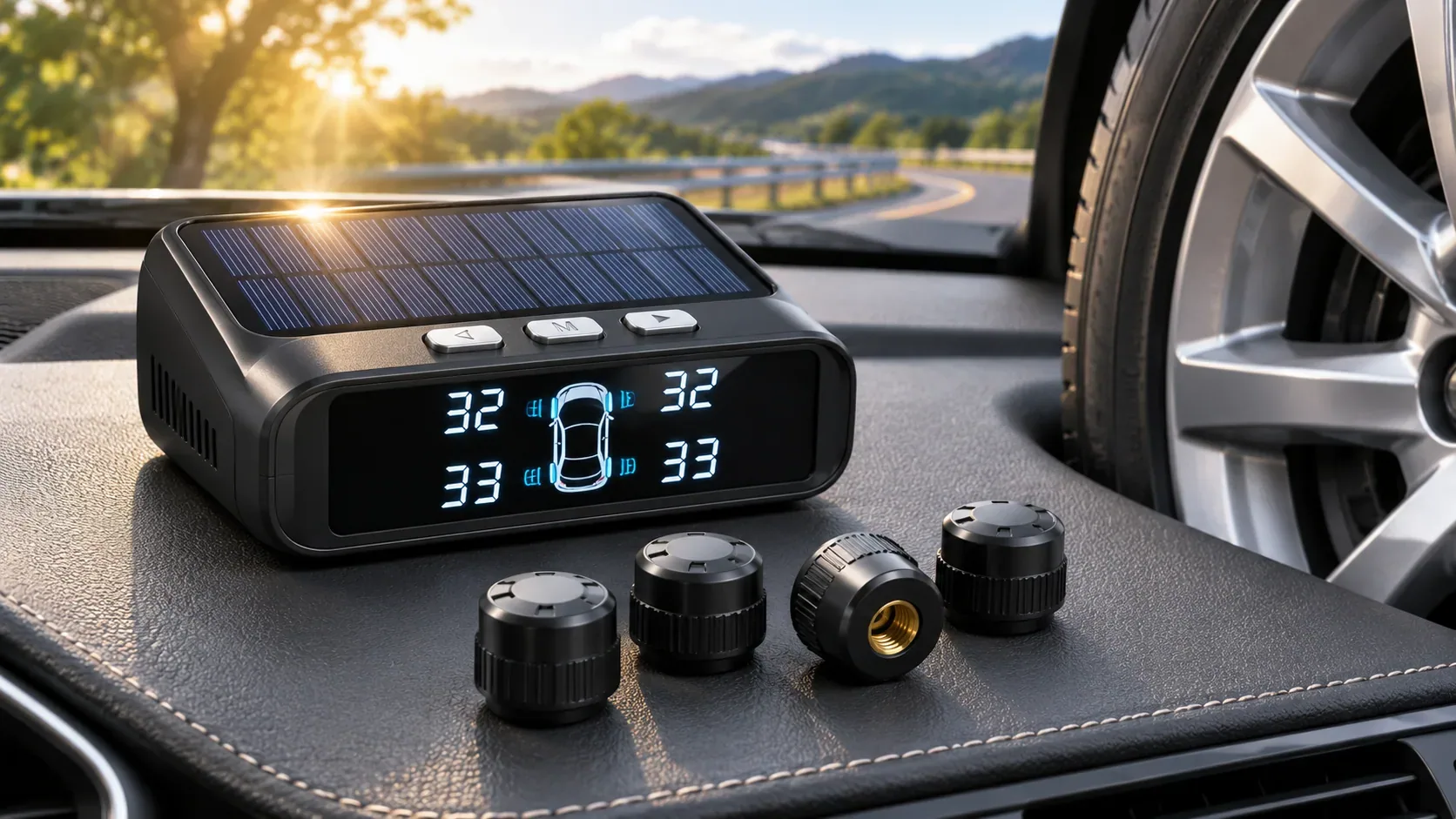
Solar Powered Tire Pressure Monitors provide a practical way to monitor tire conditions while driving. These devices typically use wireless sensors and a solar-assisted dashboard display to show pressure readings and alert you when tire conditions fall outside your selected limits.
If you're planning to purchase a monitoring system for your car, SUV, or other compatible vehicle, understanding its features, installation requirements, and limitations can help you make an informed decision.
What Are Solar Powered Tire Pressure Monitors?
Solar Powered Tire Pressure Monitors are aftermarket monitoring devices designed to track tire pressure through sensors installed on or inside your vehicle's tires.
Most systems include a compact dashboard display with an integrated solar panel. The display receives information from individual tire sensors and presents readings for each monitored wheel.
A typical Solar Tire Pressure Monitoring System includes:
- Solar-assisted display: Uses a small solar panel to supplement the display's battery charging.
- Individual tire sensors: Measure pressure and, on supported models, temperature.
- Wireless communication: Transfers sensor readings to the display without requiring cables between the tires and dashboard.
- Audible or visual warnings: Notify you when monitored conditions exceed configured limits.
- Rechargeable display battery: Helps maintain operation when sunlight is limited, depending on the model.
Although these systems use solar energy, the tire sensors generally rely on their own batteries. Therefore, solar charging does not eliminate every battery replacement requirement.
How Do Solar Powered Tire Pressure Monitors Work?
A solar-assisted monitoring system collects information from sensors attached to individual wheels and displays the readings inside your vehicle.
The process generally works as follows:
- Sensor installation: Each sensor is attached to its designated tire valve or installed inside the wheel.
- Pressure measurement: Sensors measure tire pressure at intervals determined by the device.
- Wireless transmission: The collected information is sent to the dashboard receiver.
- Information display: The monitor presents readings for individual tires.
- Warning activation: The system triggers an alert when detected conditions exceed its configured thresholds.
Some devices display temperature readings alongside tire pressure. However, sensor transmission frequency, measurement accuracy, and warning response times vary between products.
Does the Solar Panel Power the Entire System?
Not necessarily.
In most aftermarket systems, the solar panel primarily helps charge the dashboard display's internal battery. Individual tire sensors typically contain separate batteries.
Furthermore, charging performance depends on sunlight exposure, panel placement, and the device's power requirements.
If you regularly park indoors or drive at night, selecting a model with USB charging can provide additional convenience.
Key Features to Look for Before Buying
Choosing a suitable Solar Powered TPMS involves checking several technical and practical features.
1. Pressure Measurement Accuracy
Accurate readings help you identify tires that may require attention.
Before purchasing, review the manufacturer's stated measurement accuracy, supported pressure range, and pressure units.
Many devices support PSI and bar, although the available units depend on the model.
Remember that aftermarket displays may show readings that differ slightly from a handheld tire gauge.
2. High and Low Pressure Alerts
One of the main reasons to purchase a monitoring system is to receive warnings when tire pressure changes beyond acceptable limits.
Look for adjustable warning thresholds that can be configured according to your vehicle manufacturer's recommendations.
Avoid relying on factory-default thresholds without checking their suitability for your tires.
3. Tire Temperature Monitoring
Some devices measure tire temperature in addition to pressure.
Temperature monitoring can provide another indication of changing tire conditions, particularly during extended driving.
However, sensor temperature readings may not represent the hottest part of the tire. Temperature warnings should never replace regular tire inspections.
4. Solar and USB Charging
A display with solar-assisted charging can reduce how frequently you need to connect a charging cable.
Nevertheless, USB charging remains useful when sunlight is insufficient.
Check the charging specifications, battery capacity, and installation instructions before choosing a device.
5. Display Readability
Your monitor should present information clearly without requiring unnecessary attention while driving.
Useful display characteristics include:
- Adjustable screen brightness
- Clear pressure and temperature readings
- Individual tire identification
- Visible warning indicators
- Easy-to-understand menus
A compact display can be convenient, provided the numbers remain readable from your driving position.
6. Sensor Durability
External sensors are exposed to rain, dust, road debris, and changing temperatures.
Look for manufacturer-documented water resistance, suitable operating temperature limits, and replacement sensor availability.
If you choose external sensors, check that they can be secured properly without interfering with the tire valve.
External vs Internal Wireless Tire Pressure Sensors
Most aftermarket solar-assisted systems use either external or internal Wireless Tire Pressure Sensors.
Both designs measure tire conditions, although installation requirements and maintenance differ.
| Feature | External Sensors | Internal Sensors |
|---|---|---|
| Installation | Attach to compatible tire valves | Installed inside the wheel |
| Installation difficulty | Generally straightforward | Usually requires professional tire service |
| Battery replacement | Often easier on replaceable-battery models | Usually requires tire removal |
| Exposure | Exposed to external conditions | Protected inside the tire |
| Theft resistance | May include locking nuts | Generally inaccessible without wheel service |
| Best suited for | Drivers seeking convenient installation | Drivers preferring concealed sensors |
Which Sensor Type Should You Choose?
External sensors may be suitable if you prefer straightforward installation and accessible maintenance.
Internal sensors may be preferable if you want the sensors concealed within the wheels.
Before choosing either type, confirm valve compatibility, sensor weight requirements, and the manufacturer's installation recommendations.
For internal sensors, professional installation is generally advisable because the tire must be removed from the wheel.
Benefits of Using Solar Powered Tire Pressure Monitors
Convenient Pressure Checks
A monitoring display allows you to view reported tire pressure without manually checking every tire during each drive.
This can be particularly helpful during long-distance travel.
Earlier Warning of Pressure Changes
A compatible monitoring system may alert you to abnormal pressure conditions before they become obvious through vehicle handling.
However, it cannot guarantee detection of every sudden tire failure or pressure loss.
Support for Tire Maintenance
Maintaining the manufacturer's recommended cold tire pressure can help reduce irregular tire wear.
Monitoring systems can remind you when a tire needs inspection or adjustment.
Reduced Display Charging Requirements
Solar-assisted charging may extend the time between manual display charging sessions.
Actual performance depends on sunlight availability and device specifications.
Convenient Monitoring During Road Trips
Drivers traveling long distances may appreciate having individual tire readings visible on a dashboard display.
This can help identify developing pressure problems without waiting for the next scheduled tire inspection.
Solar Powered TPMS vs Factory-Installed Tire Pressure Monitoring Systems
Many modern vehicles already include factory-installed tire pressure monitoring technology.
However, the features and information provided by these systems vary.
| Comparison | Solar-Assisted Aftermarket TPMS | Factory-Installed TPMS |
|---|---|---|
| Installation | Added after vehicle purchase | Installed by vehicle manufacturer |
| Display | Usually separate dashboard unit | Integrated vehicle display or warning indicator |
| Power | Solar-assisted rechargeable display | Vehicle electronics |
| Sensor design | External or internal, depending on model | Direct or indirect monitoring |
| Pressure readings | Usually individual readings | Depends on vehicle and system |
| Compatibility | Must be checked before purchase | Designed for the specific vehicle |
Some factory-installed systems only illuminate a warning indicator, while others display individual tire pressure values.
An aftermarket device may provide additional information, although compatibility and functionality should be verified before purchase.
Importantly, an aftermarket monitor should not be treated as a replacement for a malfunctioning factory safety system.
How to Choose a Tire Pressure Monitoring System for Cars
Finding a suitable Tire Pressure Monitoring System for Cars starts with understanding your vehicle's requirements.
Check Your Vehicle's Tire Pressure Specifications
Review the tire information placard, usually located on the driver's door jamb, or consult the owner's manual.
The recommended cold tire pressure may differ between front and rear tires.
Avoid using the maximum pressure printed on the tire sidewall as your routine inflation target.
Confirm the Supported Pressure Range
Passenger cars, SUVs, trailers, and other vehicles can have different pressure requirements.
Choose a system whose supported pressure range includes your vehicle's recommended operating pressures.
Verify Sensor Compatibility
Check the tire valve type, sensor mounting requirements, and compatibility with your wheels.
If your vehicle uses special valve hardware or has limited clearance, confirm the sensors will fit safely.
Review Display Placement
Choose a dashboard location that receives suitable sunlight without blocking your view of the road.
Avoid placing the display where it could interfere with airbags, vehicle controls, or visibility.
Evaluate Replacement Parts
Before purchasing, check the availability of replacement sensors, batteries, charging accessories, and mounting components.
This can help reduce maintenance difficulties later.
What Should You Expect to Pay?
Prices vary according to sensor design, display quality, supported pressure range, manufacturer, and included accessories.
Instead of choosing a device based entirely on its initial price, evaluate its expected maintenance requirements.
For example, a lower-priced system with difficult-to-source replacement sensors may become less convenient over time.
When comparing products, check:
- The number of sensors included
- Warranty coverage
- Replacement sensor pricing
- Battery replacement requirements
- Charging options
- Installation costs
- Return and support policies
For accurate purchasing decisions, verify current pricing and specifications directly with the retailer or manufacturer.
How to Install Solar Powered Tire Pressure Monitors
Installation depends on the sensor design and device instructions.
For a typical external-sensor system, the general process involves:
- Park your vehicle safely and allow the tires to reach a suitable cold condition for pressure checking.
- Check and adjust tire pressure using an accurate gauge.
- Follow the manufacturer's instructions to prepare and pair the sensors.
- Attach each sensor to its designated tire valve.
- Secure the sensors using the supplied hardware, if applicable.
- Position the display in a safe, visible dashboard location.
- Configure the pressure warning thresholds according to your vehicle's requirements.
- Confirm that the display receives readings from all installed sensors.
After installation, inspect the valves for leaks using an appropriate leak-detection method.
Internal-sensor installation generally requires tire removal and may require wheel balancing afterward.
Always follow the instructions supplied with your specific product.
How Real-Time Tire Pressure Monitoring Helps Drivers
Real-Time Tire Pressure Monitoring provides regularly updated information about tire conditions while your vehicle is operating.
However, the term "real-time" does not necessarily mean continuous measurement or instant transmission.
Most systems collect and transmit readings at manufacturer-defined intervals. Some devices increase reporting frequency when pressure changes rapidly.
This functionality may help you identify:
- Gradual tire pressure loss
- Unusually low inflation pressure
- Excessively high pressure readings
- Temperature changes detected by supported sensors
- Differences between individual tire readings
If your monitor triggers an alert, find a safe place to stop and inspect the affected tire.
Do not ignore unusual steering behavior, vibration, or visible tire damage simply because the monitor displays a normal reading.
Common Questions About Solar Powered Tire Pressure Monitors
Are solar powered tire pressure monitors accurate?
They can provide useful pressure measurements when properly installed and maintained. However, accuracy depends on sensor quality, calibration, operating conditions, and manufacturer specifications.
For routine inflation adjustments, verify pressure with a reliable gauge when the tires are cold.
Do solar tire pressure monitors work at night?
Yes, models equipped with a charged internal display battery can operate without direct sunlight.
However, battery endurance varies between devices.
Do these systems require an internet connection?
Most standalone aftermarket systems communicate directly between the tire sensors and dashboard receiver.
They generally do not require Wi-Fi or mobile internet connectivity.
Can you install these monitors yourself?
Many external-sensor systems are designed for user installation.
Internal-sensor systems generally require tire service equipment and professional installation.
Can solar powered monitors improve fuel efficiency?
Maintaining recommended tire inflation pressure can support fuel efficiency by helping avoid unnecessary rolling resistance.
The monitor itself does not directly reduce fuel consumption. Any benefit depends on identifying and correcting improper tire pressure.
How long do tire pressure sensors last?
Sensor lifespan varies according to battery type, operating conditions, transmission frequency, and product design.
Some external sensors use replaceable batteries, while other sensor assemblies require replacement when their batteries are depleted.
Check the manufacturer's documentation for the expected service life.
Can you use these systems on an SUV or trailer?
Some models support SUVs, trailers, and other vehicles, provided their pressure ranges, sensor configurations, and wireless transmission capabilities are suitable.
For trailers, pay particular attention to sensor-to-display transmission distance and the number of wheels supported.
Conclusion: Are Solar Powered Tire Pressure Monitors Worth Buying?
Solar Powered Tire Pressure Monitors can be a practical addition to your vehicle if you want convenient tire pressure readings and configurable warning alerts.
Solar-assisted charging, wireless sensors, and individual tire monitoring make these devices useful for everyday commuting and extended drives.
However, the right choice depends on your vehicle's requirements, sensor compatibility, display visibility, and maintenance preferences.
Before purchasing, compare the manufacturer's specifications, verify the supported pressure range, and check replacement part availability.
A properly selected monitoring system can support regular tire maintenance and help you respond to abnormal pressure conditions. Continue checking your tires manually and following your vehicle manufacturer's maintenance recommendations to support safe driving.