Scale Heat Transfer Business: HTVRont Auto Heat Press
Discover how the HTVRont Auto Heat Press Machine accelerates production for small businesses. Learn automation features, efficiency gains, and ROI for scaling heat transfer operations.
If you're running a heat transfer business, you know the grind: endless hours hunched over a heat press, one item after another, watching the clock while your wrist aches and your profit margins barely budge. Small business owners in the heat transfer industry spend an average of 40+ hours per week on repetitive pressing tasks—time that could be spent growing revenue, managing clients, or refining designs. The bottleneck isn't creativity or market demand; it's production speed, plain and simple.
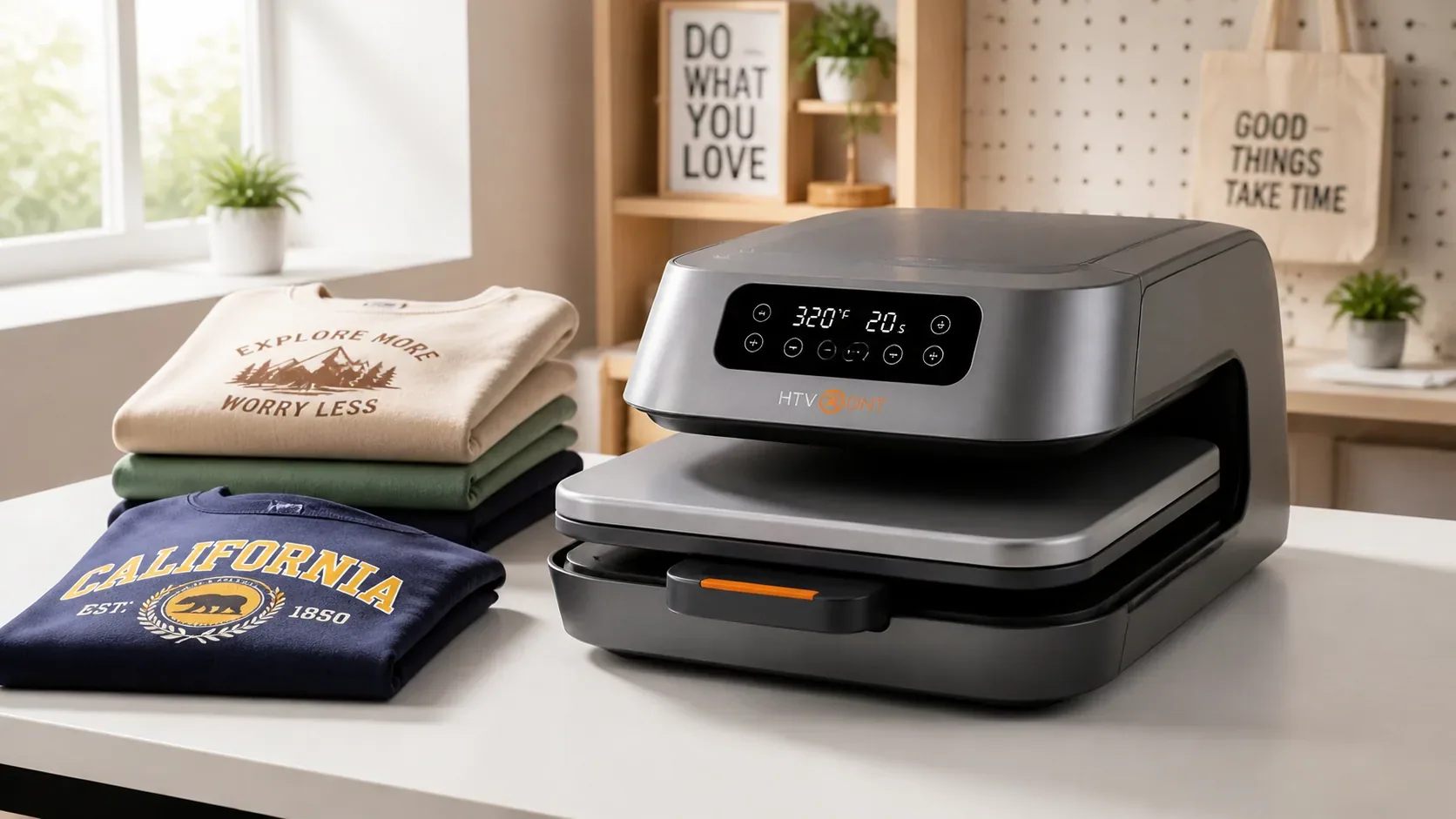
The HTVRont Auto Heat Press Machine sits at the sweet spot between hobbyist equipment and industrial machinery. Priced between $250–$400, it's engineered specifically for small-to-medium production runs without the five-figure price tag of industrial alternatives. Unlike manual clamshell presses that demand constant hand pressure and timing precision, this automatic system handles the heavy lifting through its auto press and release function, delivering consistent results across T-shirts, sweatshirts, and flat textiles while reducing operator fatigue.
Explore the HTVRont Auto Heat Press Machine today to transform your production workflow.
From Hobby to Production: Why Automation Matters for Scaling Heat Transfer Operations
The production ceiling problem
Manual pressing limits output to 15–25 units per hour. Add up a typical business day, and you're looking at 120–200 pieces maximum—even with back-to-back pressing. Automation doubles this capacity, pushing realistic throughput to 30–50 units per hour depending on material type and cooling requirements. That gap between manual and automatic translates directly into revenue opportunities: seasonal campaigns you can actually handle, bulk corporate orders you can't turn down, and the ability to promise faster turnaround times than competitors still grinding away manually.
Hand strain and repetitive stress injuries
Continuous pressing causes wrist, shoulder, and back fatigue. After months of manual operation, many heat transfer business owners develop tendonitis or carpal tunnel issues that sideline them during peak seasons. Automation eliminates this occupational hazard entirely. The auto press and release mechanism removes the need for sustained hand pressure, letting operators step away between cycles or manage other business tasks while the machine cycles independently.
Consistency as a competitive advantage
Uniform temperature, pressure, and timing reduce failed transfers and customer complaints. Manual presses introduce variables: how hard you press, how long you hold, whether the platen cooled between items. These inconsistencies result in transfers that fade prematurely, crack under stress, or look uneven compared to professional work. The HTVRont's even heat distribution across the platen and programmable timer controls eliminate guesswork, ensuring every item meets the same quality standard.
Time-to-revenue equation
Reclaim 10–15 hours per week previously spent on pressing to focus on marketing, design, or client acquisition. Those hours have real value: potential new client outreach, refining your portfolio, or building social media presence that drives growth. When you're not physically pressing items, you're doing the work that scales revenue instead of just moving product through the queue.
Scaling without hiring
Increase production without proportional labor costs, keeping profit margins healthy during growth phases. Hiring a second full-time employee costs $25,000–$35,000 annually plus benefits. A $300 heat press increases capacity immediately while keeping overhead flat. For seasonal businesses especially, automation lets you handle volume spikes without permanent payroll obligations.
Professional quality perception
Automated results look more polished and uniform, justifying premium pricing for custom orders. Customers notice the difference between a carefully pressed transfer and one done hastily on manual equipment. That perceived quality allows you to charge 15–25% more per item, turning automation into a direct profit multiplier.
Key Automation Features That Drive Production Efficiency
Auto press and release mechanism
Eliminates manual clamping, reducing cycle time per item by 30–40 seconds. On a typical production day, this savings compounds: 100 items × 35 seconds = nearly one additional hour of production per day without working harder or longer.
Adjustable temperature precision (up to 400°F)
Accommodates diverse materials—cotton blends, polyester, sublimation substrates—without guesswork. Each material type requires specific heat settings; the HTVRont's precise controls let you dial in the exact temperature needed, then repeat it consistently across batches.
Programmable timer controls
Set dwell times for specific materials and never over-press again; perfect for batch consistency. Once you've tested optimal settings for your most common products, program them into the machine. New operators follow the preset, eliminating training variance.
Even heat distribution across platen
Professional-grade heating ensures no cold spots, reducing rejects and material waste. Some manual presses develop hot and cold zones as platens age; the HTVRont's engineering maintains uniform temperature across the entire pressing surface.
Safety-focused design
Auto-stop functions and heat guards protect operators during high-volume production runs. The automatic release prevents accidental burns, and thermal cutoffs protect against overheating—critical when staff are running multiple shifts or when training new team members.
Beginner-friendly interface
Minimal learning curve means new team members or contractors can operate independently. You're not waiting for expertise to develop; someone can walk up, follow the temperature and time settings, and produce professional-quality transfers on day one.
Bulk production capability
Designed for flat items (T-shirts, tote bags, sweatshirts), the ideal product mix for most small heat transfer businesses. The machine's strengths align directly with the most profitable products for small operations.
Production Capacity & Efficiency Metrics: What You Can Actually Achieve
Realistic throughput expectations
30–50 units per hour depending on material type, press time, and cooling requirements. This isn't theoretical; it's what active users report across forums and review sites. The range reflects natural variation: lightweight cotton pressing faster than heavy blends, shorter dwell times for simple vinyl versus longer cycles for sublimation.
Cost per unit calculation
At $250–$400 investment, break-even occurs within 2–4 months for active small businesses. If you're processing 100 items monthly at $15 profit per item, you recoup your investment in just two months. Scale that to 200 items monthly, and ROI happens in weeks.
Material waste reduction
Consistent heat and pressure lower reject rates by up to 60% compared to manual pressing. Manual operators inevitably over-press or under-press occasionally, resulting in transfers that don't survive first wash or look inferior. Automation eliminates this waste, turning rejected materials into profit.
Labor cost savings
One operator can manage multiple presses or handle other tasks while the machine cycles, multiplying ROI. While one press runs, your operator designs the next batch, packs completed orders, or manages customer communications. The machine's autonomy creates flexibility that manual pressing doesn't allow.
Seasonal production spikes
Handle holiday orders or bulk campaigns without outsourcing or overtime labor. December merchandise rush? A single HTVRont handles volume that would require weekend overtime or temporary hiring on manual equipment.
Quality metrics tracking
Fewer customer complaints about fading, cracking, or uneven transfers means better reviews and repeat orders. Consistency builds reputation; reputation builds sustainable growth.
Uptime and durability
Built for continuous use, these machines typically outlast manual alternatives by 3–5 years with basic maintenance. Well-maintained HTVRont units operate reliably for 5–7 years, with some users reporting 10+ years of service.
Business Models That Thrive With the HTVRont Auto Heat Press
Custom apparel shops
T-shirt printing for corporate orders, sports teams, and events scales smoothly with automation. A shop doing 200 custom polos monthly becomes the go-to vendor in their region when they can promise consistent quality and fast turnaround.
Print-on-demand services
Etsy sellers and Shopify store owners handling 50+ orders per month see immediate efficiency gains. Order fulfillment time drops from days to hours; that speed justifies premium pricing and attracts repeat customers.
Sublimation specialists
Consistent temperature control makes this ideal for dye-sublimation on polyester and specialty blanks. Sublimation requires precise heat management; the HTVRont's accuracy eliminates color variation and ghosting issues that plague manual operations.
Tote bag and merchandise producers
Flat-item focus aligns perfectly with eco-conscious branding and corporate gifting trends. Sustainable products are booming; automation lets you meet demand without scaling to industrial operations.
Vinyl HTV operations
Reliable heat distribution ensures clean, durable vinyl transfers without adhesive issues. Vinyl demands consistent pressure and temperature; automation delivers both reliably.
Seasonal businesses
Pumpkin spice season, holiday merch, back-to-school campaigns—handle volume without permanent overhead. Scale up during peak months, let the machine sit idle during slow periods. No labor costs during downtime.
Craft studio co-ops
Multiple makers sharing equipment reduces individual investment while maintaining professional output. Six crafters pooling resources for one machine makes the investment accessible for everyone.
Investment Breakdown & ROI Timeline for Small Businesses
Purchase price range
$250–$400 depending on size (15" × 15" vs. 16" × 20") and bundle options. Entry-level models sit at the lower end; larger platforms or deluxe packages push toward $400.
Hidden costs to budget
Replacement platens ($50–$100), heat tape maintenance, and Teflon sheets for longevity. Budget $100–$200 annually for consumables and maintenance to keep the machine running optimally.
Break-even analysis
At $15–$25 profit per item, most businesses recoup investment within 100–200 completed transfers. For an active shop, that's 1–2 weeks of normal operations.
Financing options
Many suppliers offer payment plans or bundle deals to lower initial barrier to entry. If $300–$400 upfront feels risky, explore financing that spreads cost over 6–12 months.
Comparison to industrial alternatives
This mid-range option costs 60–70% less than industrial heat presses ($1,000+) while handling 80% of small business needs. Industrial equipment overkill for small operations; the HTVRont hits the efficiency sweet spot.
Productivity ROI
Saving 10 hours per week equals $200–$500 in reclaimed labor value monthly. That's $2,400–$6,000 annually in time you can redirect toward growth activities.
Resale value
Used HTVRont units retain 50–60% of purchase price, making exit strategy low-risk. If the business pivots or scales to industrial equipment, you can recoup half your investment.
Limitations & When This Machine Isn't the Right Fit
Flat items only
Irregular shapes, thick materials (leather, canvas over 12oz), and 3D objects require different equipment. If your product mix includes hats, curved items, or textured surfaces, this machine won't work for those applications.
Platen size constraints
Larger designs or oversized garments may require multiple presses or custom arrangements. Oversized jackets or banner-sized designs hit practical limits.
Footprint and workspace
Bulkier than manual clamshells; requires dedicated bench space (roughly 3' × 2'). If workspace is cramped, the HTVRont demands real estate that manual presses don't.
Upfront cost vs. manual presses
$250–$400 is steep for hobbyists doing 5–10 items monthly; manual clamshells ($80–$150) suffice for low volume. If you're making occasional items for personal use or friends, manual equipment is more economical.
Learning curve for optimization
Temperature and time settings require testing for each new material; first-time users may waste materials during calibration. Plan for a brief learning phase where you dial in settings for new product types.
Not suitable for ultra-thick items
Compression limitations mean dense materials won't transfer as reliably as on industrial presses. Heavy canvas, thick leather, or multi-layered textiles need specialized equipment.
Maintenance requirements
Regular cleaning, platen replacement, and calibration checks keep machines running smoothly but demand attention. This isn't a set-and-forget tool; neglect maintenance and performance declines.
Real-World Scenarios: When the HTVRont Auto Heat Press Pays for Itself
Scenario 1 – Corporate apparel shop
200 custom polo shirts monthly × $18 profit per shirt = $3,600 monthly revenue; machine pays for itself in 1–2 months. Within weeks, the investment becomes irrelevant; you're focused on growth.
Scenario 2 – Etsy sublimation seller
100 personalized mugs/blanks weekly × $12 profit = $4,800 monthly; ROI achieved in 3–4 weeks. High-volume sellers see payback almost immediately.
Scenario 3 – Sports team merchandise
Seasonal bulk orders (500+ items per order) at $8–$12 profit each; one order covers machine cost. Single large contracts justify the investment outright.
Scenario 4 – Print-on-demand hybrid
Shopify store handling 50–75 orders monthly; automation reduces fulfillment time from 2 weeks to 3–5 days, enabling price increases. Faster turnaround justifies premium pricing, multiplying ROI.
Scenario 5 – Craft studio co-op
Six makers sharing one machine at $60/month rental each = $360/month revenue; covers machine cost plus profit in under one year. Shared investment models work particularly well.
Scenario 6 – Seasonal business model
Holiday merchandise (Oct–Dec) producing 1,000+ items; machine enables 3–4x output compared to manual labor. Seasonal businesses see explosive ROI during peak months.
Maintenance, Durability & Long-Term Operational Costs
Routine maintenance schedule
Daily: wipe platen; weekly: check heat tape alignment; monthly: deep clean and calibration test. Simple habits keep the machine running smoothly.
Platen replacement cycles
Expect to replace platens every 12–18 months ($50–$100 per set) depending on usage intensity. Heavy daily use wears platens faster; moderate use extends lifespan.
Heat tape longevity
Quality machines last 2–3 years before needing replacement ($75–$150). Heat tape degradation is the most common wear item.
Teflon sheet protection
Invest in quality Teflon covers ($20–$30) to extend platen life and prevent adhesive buildup. Teflon sheets are cheap insurance that dramatically extends platen durability.
Temperature calibration drift
Recalibrate every 6 months to maintain accuracy; most machines hold precision within 5°F. Drift affects quality; calibration is worth the small effort.
Warranty coverage
Typical 1–2 year manufacturer warranties cover defects; extended plans available for $50–$100. Warranty protection gives peace of mind during the critical first years.
Total cost of ownership
Budget $100–$200 annually for maintenance and consumables; still far below industrial equipment costs. Over five years, total maintenance runs $500–$1,000—trivial compared to equipment cost.
Durability expectation
Well-maintained HTVRont machines operate reliably for 5–7 years, with some users reporting 10+ years of service. Longevity speaks to build quality when machines are cared for properly.
Making the Purchase Decision: Checklist & Next Steps
Volume assessment
Are you processing 50+ items monthly? If yes, automation ROI is strong; if no, manual press may suffice. Honest volume assessment determines whether you're ready for automation.
Product mix evaluation
Do 80%+ of your orders involve flat items? Confirm this machine aligns with your product catalog. If curved items, hats, or irregular products dominate, automation won't serve your operation well.
Space availability
Measure your workspace; ensure you have 3' × 2' minimum for equipment plus material staging. Physical constraints are deal-breakers; don't ignore them.
Budget confirmation
Can you allocate $250–$400 upfront, or do you need financing? Explore payment plan options. Financing removes the barrier for cash-strapped startups.
Material testing
Request demo or trial access; test the machine with your specific materials before committing. Never buy blind; hands-on experience reveals whether the machine handles your product requirements.
Supplier research
Compare HTVRont models, read user reviews on production-focused forums, and check warranty terms. Community feedback is invaluable; real users reveal strengths and weaknesses that marketing materials hide.
Timeline projection
Calculate break-even based on your current order volume and profit margins. Numbers make the decision concrete instead of emotional.
Team training plan
Identify who will operate the machine and schedule training before purchase. Smooth onboarding prevents learning-curve mistakes that waste materials.
Backup plan
Decide what happens if the machine needs repair; do you have manual backup capacity? Production resilience matters; plan for downtime.
The Bottom Line: Automation as a Growth Catalyst
Investing in the HTVRont Auto Heat Press Machine isn't just about pressing faster—it's about reclaiming your time and scaling your business without the overhead of industrial equipment. The numbers tell a compelling story: a machine that pays for itself within weeks or months, cuts production time by 50%, and eliminates the hand strain that plagues manual operators. The automation features—auto press and release, precise temperature control, and even heat distribution—aren't luxury perks; they're the foundation of consistent quality that justifies premium pricing and builds customer loyalty.
Whether you're running a custom apparel shop, scaling an Etsy sublimation business, or managing seasonal merchandise rushes, this heat press removes the production bottleneck that's holding you back. If you're moving 50+ items monthly with healthy profit margins, the HTVRont Auto Heat Press Machine becomes not just a tool—it becomes your competitive edge. The question isn't whether you can afford to invest; it's whether you can afford not to, as competitors who automate pull ahead in speed, quality, and profitability.